A missed question is a study signal
A practice score tells you what happened in one session. It does not always tell you what to study next.
A missed PMP practice question can reveal a knowledge gap, a reasoning problem, a reading mistake, or a pacing issue. A correct answer can also be useful when you selected it by guessing.
The goal is not to record every wrong answer and move on. The goal is to understand the decision that led to the answer, identify the gap, and choose the next useful study action.
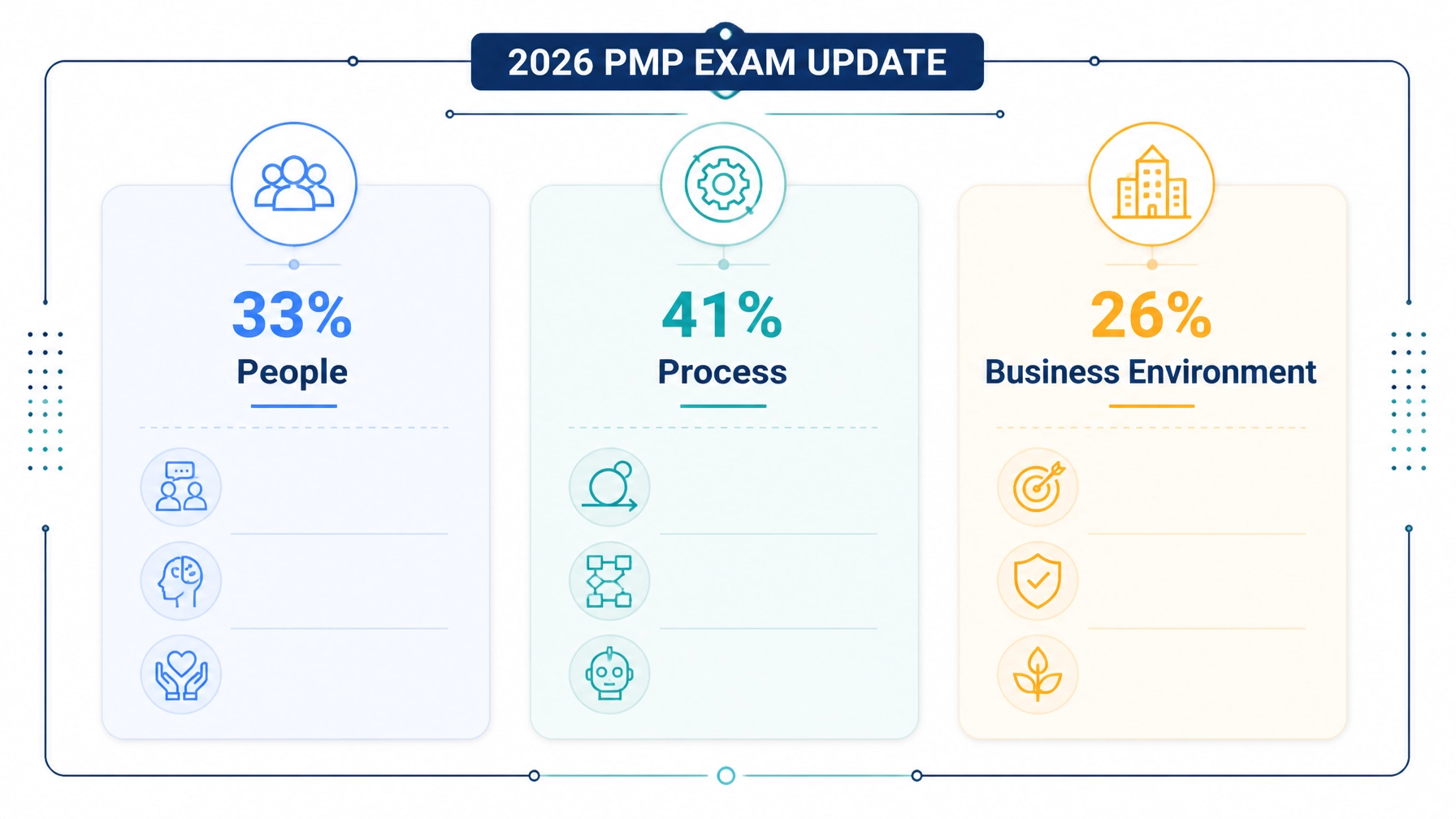
For 2026 preparation, use the official July 2026 PMP Examination Content Outline as the source for current exam content and structure. The outline describes a 180-question exam with 10 pretest questions, 240 minutes of testing time, and two 10-minute breaks. It organizes exam coverage into People at 33%, Process at 41%, and Business Environment at 26%.
Predictive, adaptive/agile, and hybrid approaches appear across all three domains. PMI states that approximately 40% of items represent predictive approaches, while the remaining 60% are divided between adaptive/agile and hybrid approaches. Exact item counts may vary by exam form.
These facts can help you organize your review. They are one planning input to consider alongside your recurring weak areas, confidence patterns, and other performance evidence. They do not create a passing score or a readiness threshold.
Why missed PMP questions are valuable
A missed question gives you more information than a question you answered correctly without thinking.
It can show that you:
- Do not understand the underlying concept.
- Understand the concept but cannot apply it to a scenario.
- Chose an action that was reasonable but not the best response.
- Confused predictive, adaptive/agile, and hybrid practices.
- Misread a key word or condition.
- Rushed because you were watching the clock.
- Recognized the topic but could not explain the answer.
The explanation is only the starting point. Ask what the question exposed about your thinking.
For example, you may miss a question about a stakeholder concern. The surface issue appears to be stakeholder engagement. On review, you may discover that the real gap is different:
- You did not identify the stakeholder’s underlying expectation.
- You selected an escalation action before understanding the concern.
- You applied a communication approach that did not fit the situation.
- You knew the general concept but missed the sequence of actions.
That distinction matters. Each gap requires a different response.
Review correct answers that you guessed
Do not review only incorrect answers.
Mark an answer as uncertain when you:
- Eliminated options but were not sure.
- Changed your answer at the last moment.
- Chose an option because it sounded familiar.
- Remembered a term but could not explain it.
- Selected the answer without identifying why the other options were weaker.
A correct guess may hide a gap. If you treat it as fully mastered, the same concept may cause trouble in a different scenario.
Use a simple confidence label after each question:
- Confident: You knew the concept and could explain the choice.
- Uncertain: You selected the correct answer but were not sure why.
- Incorrect: Your answer did not match the best answer.
- Slow: You reached the answer correctly but used too much time.
This creates a more useful review set than a basic list of wrong answers.
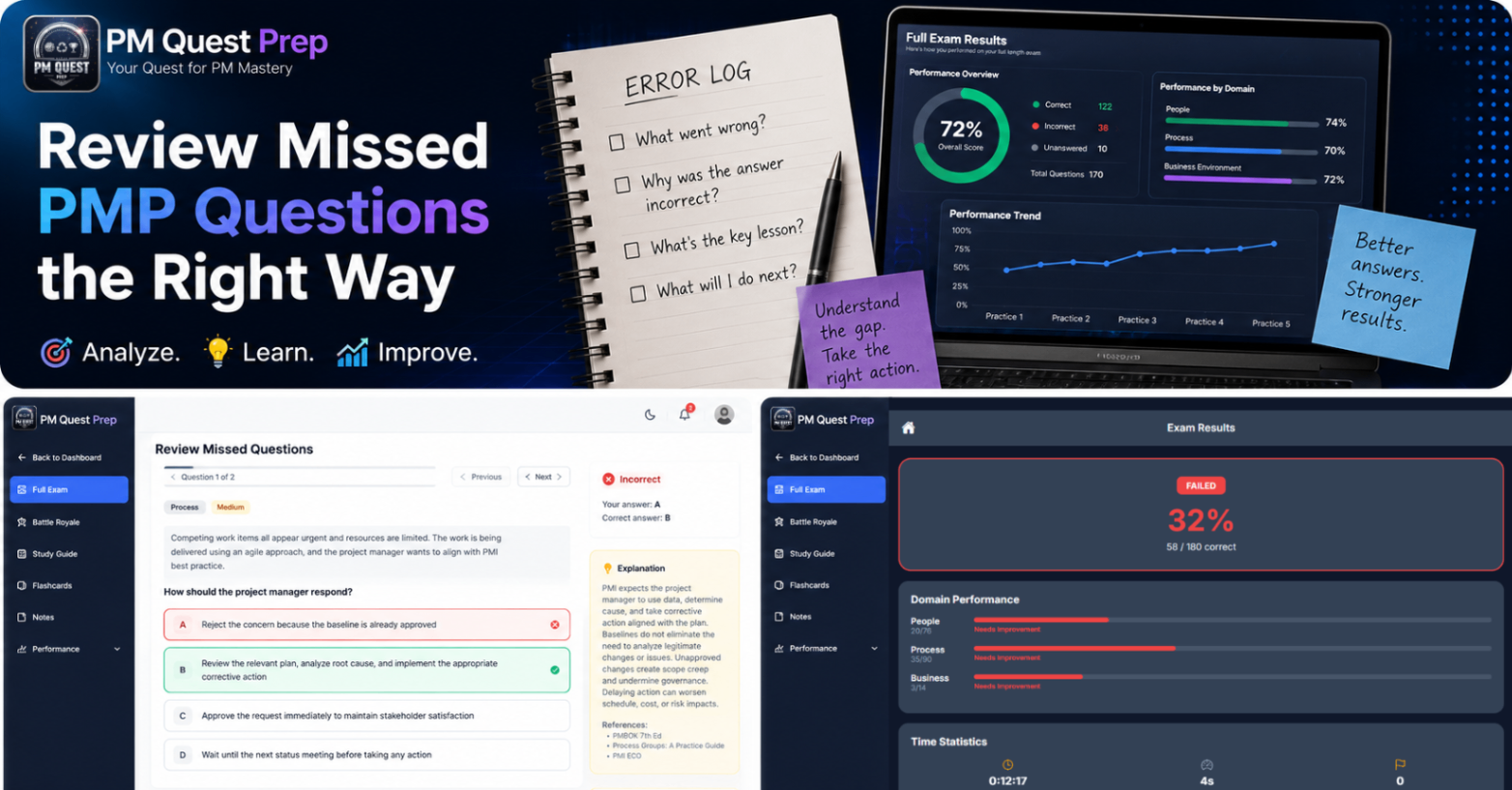
Use a simple error log
An error log should be easy to update on a phone. It should not become another large study project.
Record one question at a time. Use the same fields consistently.
The following is a study example, not a PMI-prescribed format or instruction.
Mobile-friendly error-log entry
Entry: 01
Date: August 24, 2026
Source or session: Timed practice session
Result: Incorrect
Confidence before review: Confident
Domain: People
Task or topic: Stakeholder engagement
Approach: Hybrid
Question type: Scenario
My answer: Escalate the concern to the sponsor immediately
Best answer: First clarify the stakeholder’s concern and assess its impact
Why I missed it: I treated escalation as the first action without gathering enough information
Reasoning gap: Sequencing and stakeholder analysis
Key lesson: Understand the concern and its context before choosing an intervention
Next action: Review stakeholder engagement and complete a short scenario set
Revisit date: August 27, 2026
This format separates the answer from the diagnosis. It also gives you a clear next action.
Avoid copying the entire question into the log if that makes review difficult. Record enough context to recognize the issue without creating a second question bank.
Diagnose the reasoning gap
After you see the correct answer, do not immediately write “I need to study this topic.”
Be more specific. Ask these questions:
Did I lack the knowledge?
You may have a knowledge gap when you:
- Cannot define the main concept.
- Do not recognize an important term.
- Cannot explain why the correct answer is correct.
- Confuse two related concepts.
- Need to look up the basic meaning before continuing.
Next step: Review the relevant concept, definition, process, or guidance. Then explain it in your own words.
Did I misapply what I knew?
You may have an application gap when you can define the concept but choose the wrong action in a scenario.
This often happens when you:
- Apply a predictive response to an adaptive/agile situation.
- Focus on an output instead of the outcome or value.
- Skip analysis and move directly to action.
- Choose a familiar process without considering the scenario.
- Treat all stakeholder, risk, or team problems the same way.
Next step: Review two or three variations of the same situation. Focus on what changes when the project approach, stakeholder need, or constraint changes.
Did I misread the question?
A reading mistake may be involved when you understand the topic after a careful reread but missed a condition in the original prompt.
Look for words such as:
- First
- Next
- Best
- Most likely
- Except
- Already approved
- Has just occurred
Next step: Practice identifying the subject, condition, requested action, and timing before reviewing the answer options.
Did pacing affect the result?
A pacing issue may be involved when you answer correctly in an untimed setting but make avoidable mistakes during timed practice.
Record whether you:
- Rushed the final part of the question.
- Spent too long comparing similar options.
- Lost concentration after a difficult scenario.
- Changed an answer without a clear reason.
- Had less time to review later questions.
Next step: Use shorter timed blocks and review whether the problem is speed, concentration, or decision-making.
One question can have more than one cause. A difficult topic may become a reading mistake when you are tired or behind schedule.
Review patterns across multiple sessions
One missed question may be an isolated event. A repeated pattern deserves attention.
Review your error log after several practice sessions instead of reacting to every individual result. Look for repeated combinations:
- The same domain.
- The same topic or task.
- The same project approach.
- The same type of reasoning mistake.
- The same confidence pattern.
- The same pacing problem.
For example, your log may show:
- Confident errors in Process questions about quality.
- Correct guesses in Business Environment questions about compliance.
- Slow answers in hybrid risk scenarios.
- Reading mistakes when questions contain several stakeholders.
That pattern is more useful than a single overall percentage. It tells you where to focus and what kind of practice to choose.
Use the 2026 ECO domains as review labels. The People, Process, and Business Environment percentages describe exam coverage, not a rule for how your study time must be divided. Use them as one planning input alongside your recurring weak areas, confidence patterns, and other performance evidence.
[Image placement note: Add an approved PM Quest Prep branded visual related to reviewing performance trends here.]
Know when to revisit a topic
Revisit a topic immediately when:
- You cannot explain the correct answer.
- You missed the same concept more than once.
- The topic affects several related questions.
- You confused a basic term or principle.
- The error involves a recurring decision sequence.
Schedule a later review when:
- You understood the explanation after rereading.
- The issue was mainly a rushed reading mistake.
- The question was correct but slow.
- You made an isolated error in a familiar topic.
A later review tests whether the lesson stayed with you. If you review only while the explanation is fresh, recognition can feel like mastery.
Use a revisit date in your error log. At that time, explain the concept without looking at the original answer. Then complete a small, focused practice set.
Follow review with targeted practice
Targeted practice should follow diagnosis, not replace it.
Choose the next activity based on the type of gap:
- Knowledge gap: Review the concept, then answer focused questions.
- Application gap: Practice scenarios that change the context or project approach.
- Reading gap: Slow down briefly and identify the question’s conditions before selecting an answer.
- Pacing gap: Use timed blocks and track whether speed improves without lowering attention.
- Confidence gap: Rework correct-but-guessed questions and explain the reasoning aloud or in writing.
- Repeated domain gap: Select domain-focused practice and compare results across sessions.
Keep the practice narrow enough to reveal whether the review helped. A large mixed session can hide the effect of one correction.
After the focused practice, add a short note:
What changed?
I now identify whether the question asks for the first action or the final resolution.
What will I watch for next time?
I will confirm the scenario condition before comparing answer choices.
This turns a missed question into a repeatable decision rule.
A practical review routine
Use this process after each PMP practice session:
- Mark incorrect answers.
- Mark correct answers that involved guessing.
- Label slow answers.
- Record the domain, topic, and approach.
- Explain why your answer was weaker.
- Write the key lesson in one sentence.
- Choose a specific next action.
- Set a revisit date.
- Review patterns across multiple sessions.
- Use targeted practice to test the correction.
This routine keeps practice connected to learning. It also helps you avoid studying only the topics that feel comfortable.
Use an optional study tool
PM Quest Prep is an independent study platform that can support this workflow with PMP practice questions, explanations, focused practice, performance tracking, and related study tools. Candidates can review their performance and choose focused practice through the PM Quest Prep platform.
Use any third-party study tool as educational support. Verify current exam information, requirements, policies, and account-specific details through PMI. If a detail is not publicly confirmed, review the terms and information presented within your own PMI account.
Disclaimer
PM Quest Prep is an independent educational platform. It is not affiliated with, sponsored by, endorsed by, or approved by PMI®. It does not provide official PMI exam questions.
PMP®, PMI®, PMBOK®, and related marks belong to Project Management Institute, Inc.