Category: PMP Prep

PMP exam preparation strategies, practice guidance, exam updates, and study resources for current PMP candidates.

  • PMP Practice Questions: How to Review Missed Questions the Right Way

    PMP Practice Questions: How to Review Missed Questions the Right Way

    A missed question is a study signal

    A practice score tells you what happened in one session. It does not always tell you what to study next.

    A missed PMP practice question can reveal a knowledge gap, a reasoning problem, a reading mistake, or a pacing issue. A correct answer can also be useful when you selected it by guessing.

    The goal is not to record every wrong answer and move on. The goal is to understand the decision that led to the answer, identify the gap, and choose the next useful study action.

    For 2026 preparation, use the official July 2026 PMP Examination Content Outline as the source for current exam content and structure. The outline describes a 180-question exam with 10 pretest questions, 240 minutes of testing time, and two 10-minute breaks. It organizes exam coverage into People at 33%, Process at 41%, and Business Environment at 26%.

    Predictive, adaptive/agile, and hybrid approaches appear across all three domains. PMI states that approximately 40% of items represent predictive approaches, while the remaining 60% are divided between adaptive/agile and hybrid approaches. Exact item counts may vary by exam form.

    These facts can help you organize your review. They are one planning input to consider alongside your recurring weak areas, confidence patterns, and other performance evidence. They do not create a passing score or a readiness threshold.

    Why missed PMP questions are valuable

    A missed question gives you more information than a question you answered correctly without thinking.

    It can show that you:

    • Do not understand the underlying concept.
    • Understand the concept but cannot apply it to a scenario.
    • Chose an action that was reasonable but not the best response.
    • Confused predictive, adaptive/agile, and hybrid practices.
    • Misread a key word or condition.
    • Rushed because you were watching the clock.
    • Recognized the topic but could not explain the answer.

    The explanation is only the starting point. Ask what the question exposed about your thinking.

    For example, you may miss a question about a stakeholder concern. The surface issue appears to be stakeholder engagement. On review, you may discover that the real gap is different:

    • You did not identify the stakeholder’s underlying expectation.
    • You selected an escalation action before understanding the concern.
    • You applied a communication approach that did not fit the situation.
    • You knew the general concept but missed the sequence of actions.

    That distinction matters. Each gap requires a different response.

    Review correct answers that you guessed

    Do not review only incorrect answers.

    Mark an answer as uncertain when you:

    • Eliminated options but were not sure.
    • Changed your answer at the last moment.
    • Chose an option because it sounded familiar.
    • Remembered a term but could not explain it.
    • Selected the answer without identifying why the other options were weaker.

    A correct guess may hide a gap. If you treat it as fully mastered, the same concept may cause trouble in a different scenario.

    Use a simple confidence label after each question:

    • Confident: You knew the concept and could explain the choice.
    • Uncertain: You selected the correct answer but were not sure why.
    • Incorrect: Your answer did not match the best answer.
    • Slow: You reached the answer correctly but used too much time.

    This creates a more useful review set than a basic list of wrong answers.

    Use a simple error log

    An error log should be easy to update on a phone. It should not become another large study project.

    Record one question at a time. Use the same fields consistently.

    The following is a study example, not a PMI-prescribed format or instruction.

    Mobile-friendly error-log entry

    Entry: 01
    Date: August 24, 2026
    Source or session: Timed practice session
    Result: Incorrect
    Confidence before review: Confident
    Domain: People
    Task or topic: Stakeholder engagement
    Approach: Hybrid
    Question type: Scenario
    My answer: Escalate the concern to the sponsor immediately
    Best answer: First clarify the stakeholder’s concern and assess its impact
    Why I missed it: I treated escalation as the first action without gathering enough information
    Reasoning gap: Sequencing and stakeholder analysis
    Key lesson: Understand the concern and its context before choosing an intervention
    Next action: Review stakeholder engagement and complete a short scenario set
    Revisit date: August 27, 2026

    This format separates the answer from the diagnosis. It also gives you a clear next action.

    Avoid copying the entire question into the log if that makes review difficult. Record enough context to recognize the issue without creating a second question bank.

    Diagnose the reasoning gap

    After you see the correct answer, do not immediately write “I need to study this topic.”

    Be more specific. Ask these questions:

    Did I lack the knowledge?

    You may have a knowledge gap when you:

    • Cannot define the main concept.
    • Do not recognize an important term.
    • Cannot explain why the correct answer is correct.
    • Confuse two related concepts.
    • Need to look up the basic meaning before continuing.

    Next step: Review the relevant concept, definition, process, or guidance. Then explain it in your own words.

    Did I misapply what I knew?

    You may have an application gap when you can define the concept but choose the wrong action in a scenario.

    This often happens when you:

    • Apply a predictive response to an adaptive/agile situation.
    • Focus on an output instead of the outcome or value.
    • Skip analysis and move directly to action.
    • Choose a familiar process without considering the scenario.
    • Treat all stakeholder, risk, or team problems the same way.

    Next step: Review two or three variations of the same situation. Focus on what changes when the project approach, stakeholder need, or constraint changes.

    Did I misread the question?

    A reading mistake may be involved when you understand the topic after a careful reread but missed a condition in the original prompt.

    Look for words such as:

    • First
    • Next
    • Best
    • Most likely
    • Except
    • Already approved
    • Has just occurred

    Next step: Practice identifying the subject, condition, requested action, and timing before reviewing the answer options.

    Did pacing affect the result?

    A pacing issue may be involved when you answer correctly in an untimed setting but make avoidable mistakes during timed practice.

    Record whether you:

    • Rushed the final part of the question.
    • Spent too long comparing similar options.
    • Lost concentration after a difficult scenario.
    • Changed an answer without a clear reason.
    • Had less time to review later questions.

    Next step: Use shorter timed blocks and review whether the problem is speed, concentration, or decision-making.

    One question can have more than one cause. A difficult topic may become a reading mistake when you are tired or behind schedule.

    Review patterns across multiple sessions

    One missed question may be an isolated event. A repeated pattern deserves attention.

    Review your error log after several practice sessions instead of reacting to every individual result. Look for repeated combinations:

    • The same domain.
    • The same topic or task.
    • The same project approach.
    • The same type of reasoning mistake.
    • The same confidence pattern.
    • The same pacing problem.

    For example, your log may show:

    • Confident errors in Process questions about quality.
    • Correct guesses in Business Environment questions about compliance.
    • Slow answers in hybrid risk scenarios.
    • Reading mistakes when questions contain several stakeholders.

    That pattern is more useful than a single overall percentage. It tells you where to focus and what kind of practice to choose.

    Use the 2026 ECO domains as review labels. The People, Process, and Business Environment percentages describe exam coverage, not a rule for how your study time must be divided. Use them as one planning input alongside your recurring weak areas, confidence patterns, and other performance evidence.

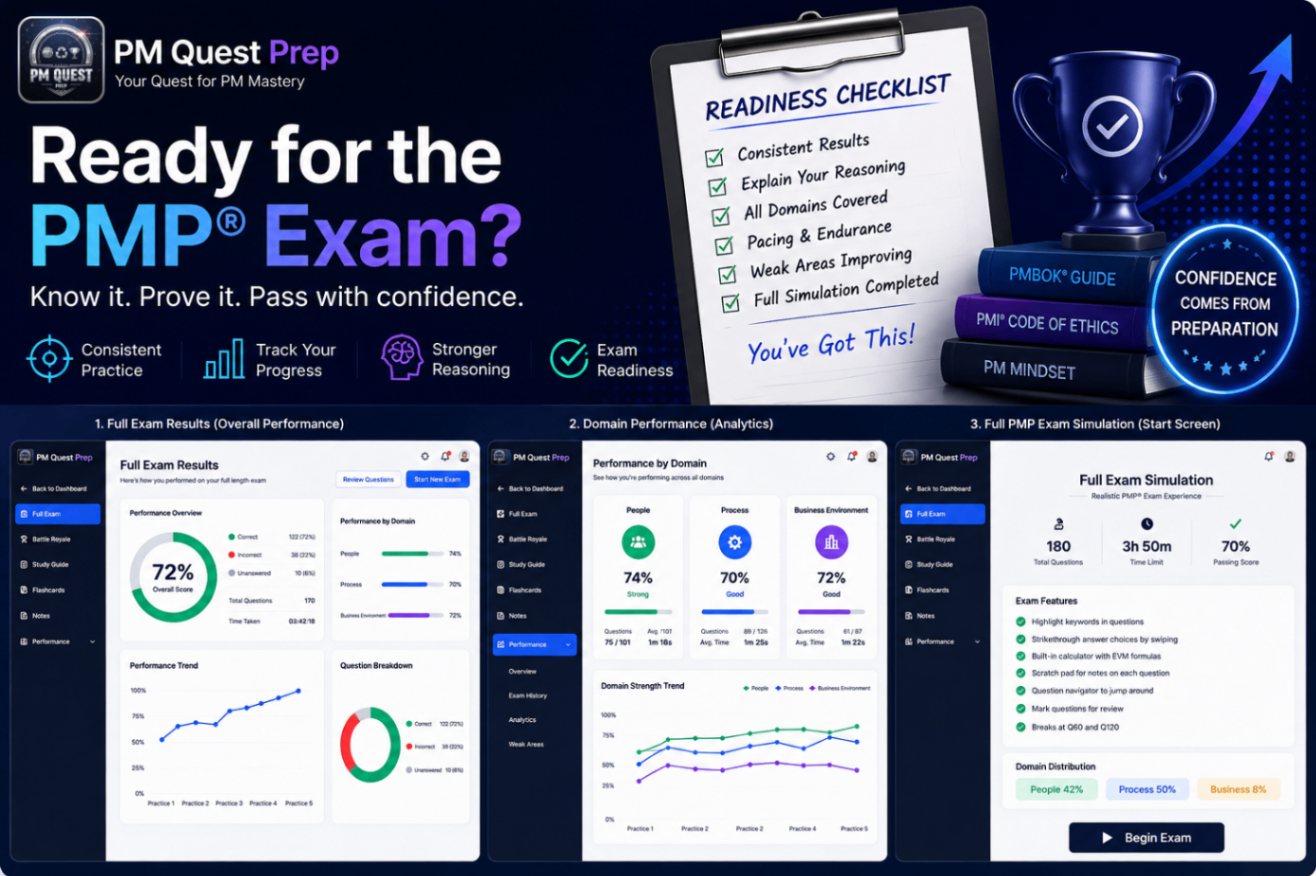
    [Image placement note: Add an approved PM Quest Prep branded visual related to reviewing performance trends here.]

    Know when to revisit a topic

    Revisit a topic immediately when:

    • You cannot explain the correct answer.
    • You missed the same concept more than once.
    • The topic affects several related questions.
    • You confused a basic term or principle.
    • The error involves a recurring decision sequence.

    Schedule a later review when:

    • You understood the explanation after rereading.
    • The issue was mainly a rushed reading mistake.
    • The question was correct but slow.
    • You made an isolated error in a familiar topic.

    A later review tests whether the lesson stayed with you. If you review only while the explanation is fresh, recognition can feel like mastery.

    Use a revisit date in your error log. At that time, explain the concept without looking at the original answer. Then complete a small, focused practice set.

    Follow review with targeted practice

    Targeted practice should follow diagnosis, not replace it.

    Choose the next activity based on the type of gap:

    • Knowledge gap: Review the concept, then answer focused questions.
    • Application gap: Practice scenarios that change the context or project approach.
    • Reading gap: Slow down briefly and identify the question’s conditions before selecting an answer.
    • Pacing gap: Use timed blocks and track whether speed improves without lowering attention.
    • Confidence gap: Rework correct-but-guessed questions and explain the reasoning aloud or in writing.
    • Repeated domain gap: Select domain-focused practice and compare results across sessions.

    Keep the practice narrow enough to reveal whether the review helped. A large mixed session can hide the effect of one correction.

    After the focused practice, add a short note:

    What changed?
    I now identify whether the question asks for the first action or the final resolution.

    What will I watch for next time?
    I will confirm the scenario condition before comparing answer choices.

    This turns a missed question into a repeatable decision rule.

    A practical review routine

    Use this process after each PMP practice session:

    1. Mark incorrect answers.
    2. Mark correct answers that involved guessing.
    3. Label slow answers.
    4. Record the domain, topic, and approach.
    5. Explain why your answer was weaker.
    6. Write the key lesson in one sentence.
    7. Choose a specific next action.
    8. Set a revisit date.
    9. Review patterns across multiple sessions.
    10. Use targeted practice to test the correction.

    This routine keeps practice connected to learning. It also helps you avoid studying only the topics that feel comfortable.

    Use an optional study tool

    PM Quest Prep is an independent study platform that can support this workflow with PMP practice questions, explanations, focused practice, performance tracking, and related study tools. Candidates can review their performance and choose focused practice through the PM Quest Prep platform.

    Use any third-party study tool as educational support. Verify current exam information, requirements, policies, and account-specific details through PMI. If a detail is not publicly confirmed, review the terms and information presented within your own PMI account.

    Disclaimer

    PM Quest Prep is an independent educational platform. It is not affiliated with, sponsored by, endorsed by, or approved by PMI®. It does not provide official PMI exam questions.

    PMP®, PMI®, PMBOK®, and related marks belong to Project Management Institute, Inc.
    Suggested links

    Internal links

    External source

  • How to Study for the PMP Exam in 2026 Without Wasting Time

    How to Study for the PMP Exam in 2026 Without Wasting Time

    Preparing for the PMP exam does not require filling every spare hour with study materials. It requires a clear plan, deliberate practice, and regular review of the decisions behind each answer.

    That distinction matters for working professionals. A busy schedule leaves less room for unfocused reading, repeated low-value quizzes, and study sessions that produce activity without improving understanding.

    The most efficient approach to PMP exam preparation is to study from the current blueprint, practice realistic scenarios, learn from mistakes, and adjust your routine based on evidence. The following PMP study strategy is designed to help you make better use of the time you already have.

    Start with the July 2026 PMP Examination Content Outline

    For the current PMP exam, start with PMI’s July 2026 PMP Certification Examination Content Outline.

    The July 2026 ECO confirms:

    • 180 total questions
    • 240 minutes of exam time
    • Two 10-minute breaks
    • People: 33%
    • Process: 41%
    • Business Environment: 26%

    The ECO also states that predictive, adaptive/agile, and hybrid approaches appear across the domains. Approximately 40% of items represent predictive approaches, while the remaining 60% are divided between adaptive/agile and hybrid approaches. The exact distribution may vary by exam form.

    Review the official July 2026 PMP Examination Content Outline before building your schedule.

    Turn the ECO into a study checklist

    The ECO is organized into:

    • Domains: Broad areas of project management responsibility
    • Tasks: Responsibilities a project manager may perform
    • Enablers: Illustrative examples that help explain each task

    Create a simple checklist with one line for each task. Then add three columns:

    Task Confidence Evidence
    Task or topic Green, amber, or red Notes from practice and review

    Use green for topics you can explain and apply. Use amber for topics that require more practice. Use red for topics you regularly misunderstand or guess.

    This turns the ECO into an active plan. It also prevents you from spending equal time on every topic when your performance shows that some areas need more attention.

    Study scenarios, not isolated facts

    The ECO explains that candidates must apply project management concepts and experience to on-the-job situations through scenario-based questions. That means memorizing definitions alone is unlikely to be an efficient PMP study strategy.

    When you study a concept, ask:

    1. What situation does this concept address?
    2. What information would a project manager need first?
    3. Which project approach or context applies?
    4. What is the immediate need in the scenario?
    5. What action supports the team, process, value, governance, or project outcome?

    For example, do not study risk responses only as a list of terms. Practice identifying whether a situation describes an uncertain event, an active issue, an impediment, or a change request. The useful knowledge is not only the definition. It is knowing how the distinction affects the next step.

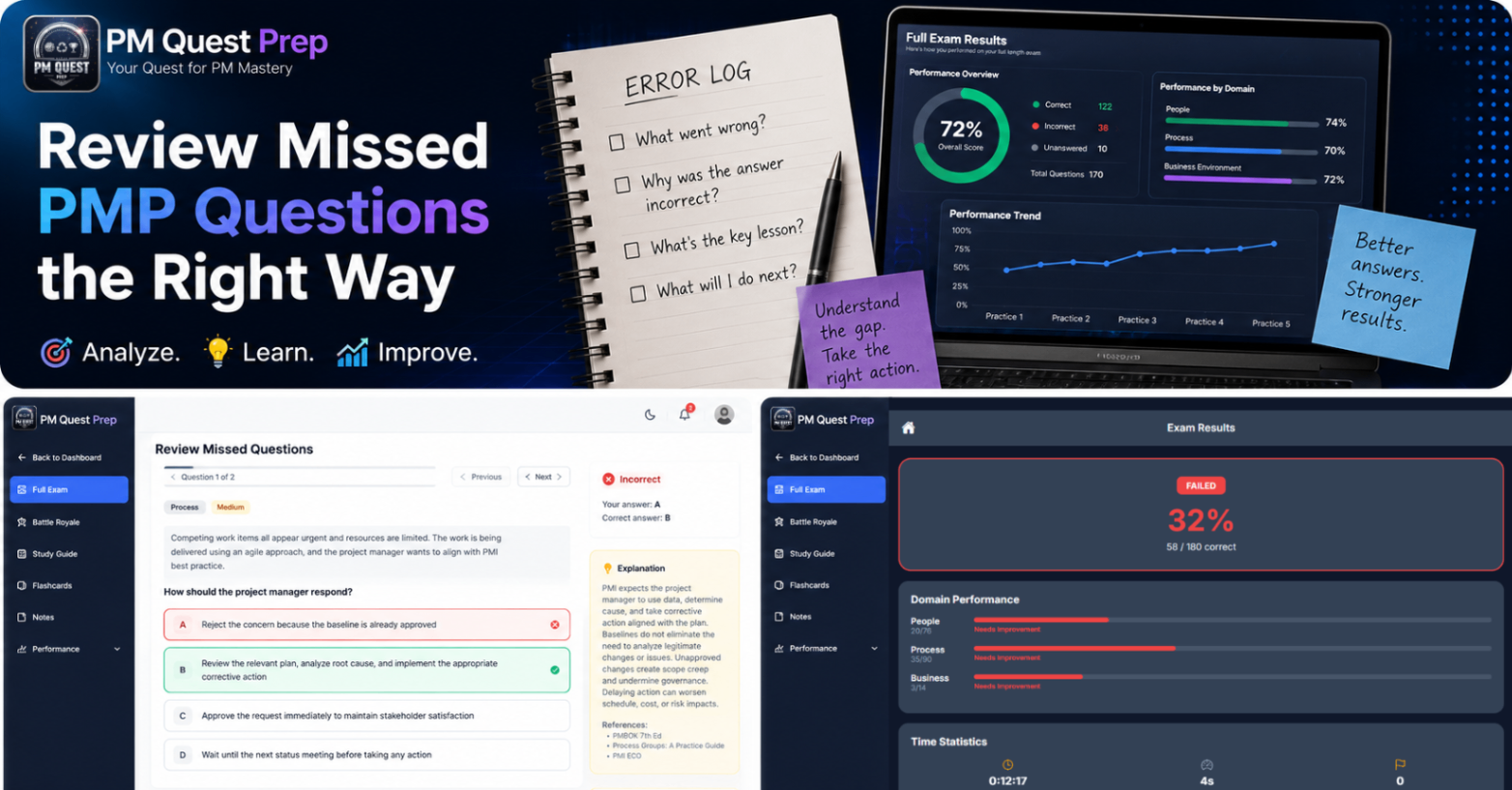
    [Image placement note: Add an approved PM Quest Prep branded visual illustrating scenario-based PMP study here.]

    Use a consistent scenario-reading method

    A practical method for PMP practice questions is:

    • Identify the situation. What happened, and what is the question asking?
    • Determine the context. Is the project predictive, adaptive/agile, or hybrid?
    • Find the immediate need. Does the team need clarity, information, collaboration, a decision, or escalation?
    • Remove premature actions. Be cautious about choices that skip analysis, communication, alignment, or an established process.
    • Compare the remaining answers. Choose the response that best fits the facts and supports the project’s objectives.

    These are study heuristics, not guaranteed PMI rules for every question. The scenario controls the answer. Avoid applying a memorized formula when the facts point somewhere else.

    Use PMP practice questions as a learning tool

    Practice questions are most valuable when they expose how you think. A score can show a result, but it does not explain whether you understood the topic, eliminated options correctly, or guessed successfully.

    After each question, record one of three outcomes:

    • Correct and understood
    • Correct but uncertain
    • Incorrect

    The second category is important. A correct answer based on weak reasoning is still a review opportunity.

    Review every important question

    For questions you missed or answered with uncertainty, write down:

    • The topic or ECO task
    • What the question was testing
    • The key facts in the scenario
    • Why your selected answer was wrong
    • Why the best answer was better
    • What you will review next

    A simple error log might look like this:

    Example error log entry: Stakeholder engagement

    • What the question tested: Tailoring communication
    • Why my answer was wrong: I chose a broad update before analyzing needs.
    • Why the best answer was better: The better option addressed the stakeholder’s specific concern first.
    • Next review: Stakeholder analysis and communication

    Example error log entry: Risk and issues

    • What the question tested: Difference between risk and issue
    • Why my answer was wrong: I treated an active problem as an uncertain event.
    • Why the best answer was better: The situation required issue resolution and collaboration.
    • Next review: Risk-to-issue transitions

    Do not copy long explanations into your notes. Reduce each mistake to a short rule or decision point that you can recognize in another scenario.

    Track weak areas and change your study plan

    A PMP study plan should change as your evidence changes. If you continue taking mixed quizzes without reviewing patterns, you may spend time practicing the same mistakes.

    At the end of each week, review:

    • Which ECO tasks produced the most errors?
    • Which topics caused uncertainty even when answers were correct?
    • Are errors caused by knowledge gaps, misreading, pacing, or answer comparison?
    • Are you struggling with one project approach more than another?
    • Are you improving after reviewing the explanation?

    Then adjust the next week’s schedule.

    For example, if your results show repeated confusion around governance and change control, replace one general quiz session with a focused review session. If you understand the topic but lose accuracy under time pressure, use shorter timed sets rather than reading another chapter.

    Do not use arbitrary score thresholds as proof that you are ready. Practice results are useful evidence, but they are not a guarantee of exam performance. Look for stronger reasoning, fewer repeated errors, better pacing, and more consistent performance across topics.

    Mix focused practice with full simulated exams

    Focused practice and full simulations serve different purposes.

    Use focused practice when you need to learn

    Choose a domain or task-focused session when:

    • You are beginning a topic
    • You have recurring errors in one area
    • You need to compare predictive, adaptive/agile, and hybrid contexts
    • You want immediate feedback
    • You are reviewing an error log

    Focused practice helps you isolate a problem. It is usually more efficient than taking a full exam when you are still building understanding.

    Use full simulations when you need to test endurance

    A full simulation is useful when you can already work through mixed scenarios and want to assess:

    • Pacing across the complete exam duration
    • Concentration over an extended session
    • Break timing
    • The effect of uncertainty on decision-making
    • Whether weak areas appear again in a mixed environment

    Because the official July 2026 ECO describes a 180-question, 240-minute exam with two 10-minute breaks, use a simulation that clearly explains the structure it is designed to represent. Confirm any current exam delivery details directly with PMI.

    After a simulation, do not immediately take another one. Reserve time to review the questions that were wrong, uncertain, or unusually slow.

    Build a realistic weekly PMP study plan

    A workable routine is better than an ambitious schedule that collapses after one busy week. Plan around your actual responsibilities, not an idealized version of your calendar.

    Here is one flexible example for a working professional:

    Monday: Short review

    Spend 20 to 30 minutes reviewing flashcards, glossary terms, or notes from your error log.

    Tuesday: Focused practice

    Complete a short set on one ECO task. Review every incorrect or uncertain answer.

    Wednesday: Break or light study

    Use this day for a brief explanation review, or take a planned break.

    Thursday: Mixed practice

    Complete a mixed set covering more than one domain or approach. Focus on reading the scenario carefully.

    Saturday: Longer session

    Study for 60 to 120 minutes. Alternate between focused review and timed practice based on your weekly performance.

    Sunday: Weekly review

    Update your checklist and error log. Choose the next week’s priority topics.

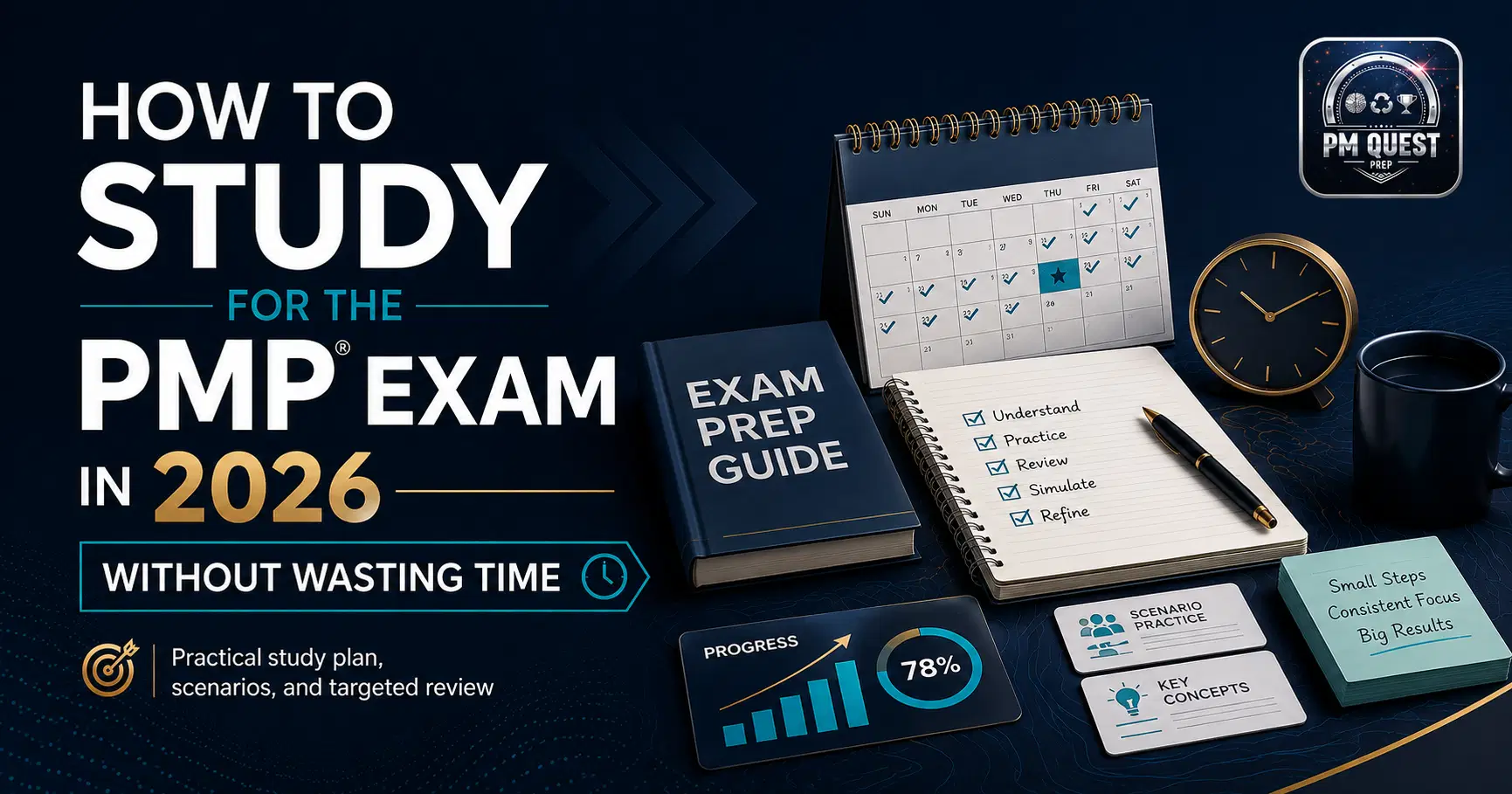
    [Image placement note: Add an approved PM Quest Prep branded visual for a flexible weekly study routine here.]

    If your schedule changes, keep the sequence rather than the exact days:

    1. Review
    2. Practice
    3. Analyze
    4. Adjust
    5. Repeat

    Short sessions can work well when they are specific. “Study project management” is difficult to start and difficult to measure. “Review three stakeholder-engagement errors and complete ten related questions” is clearer.

    Avoid common time-wasting study habits

    Some study habits feel productive but produce limited improvement.

    Reading without testing

    Reading can introduce a topic, but it does not show whether you can apply it. Pair each reading session with questions, a short explanation, or a scenario summary.

    Taking questions without reviewing them

    A large question count does not automatically create better understanding. Review incorrect, uncertain, and slow answers.

    Repeating only comfortable topics

    Familiar topics may produce better scores while leaving important gaps untouched. Use your performance data to choose some sessions outside your preferred areas.

    Memorizing answer patterns

    Rules such as “always choose the collaborative answer” can mislead you. The best response depends on the scenario, project context, and immediate need.

    Switching resources too often

    Choose a small set of reliable resources. Changing books, videos, and question banks every few days creates setup time and makes it harder to see progress.

    Know when review is better than more questions

    Additional questions are not always the best next step. Pause and review when:

    • You cannot explain why the correct answer is better
    • You are missing the same concept repeatedly
    • You are guessing between two options
    • You are answering correctly but cannot explain the scenario
    • Your timing is worsening because you are rereading the same topic
    • You are collecting notes faster than you can use them

    Use the pause to revisit the relevant ECO task, create a short comparison, or explain the concept in your own words. Return to practice after you can describe the decision clearly.

    Use a simple final seven-day review strategy

    A final review should consolidate your preparation, not introduce an entirely new curriculum. This seven-day outline is a flexible option, not a PMI requirement or a universal formula.

    • Day 7: Review the ECO checklist and identify remaining amber or red topics.
    • Day 6: Complete focused practice for the highest-priority topic.
    • Day 5: Review your error log and revisit recurring decision patterns.
    • Day 4: Complete mixed, timed practice across domains and approaches.
    • Day 3: Take a full simulation if you still need to assess pacing and endurance.
    • Day 2: Review the simulation and key notes. Keep the session focused.
    • Day 1: Use light review only. Confirm your appointment, delivery instructions, identification requirements, and other terms through your PMI account and official PMI instructions.

    Do not measure the final week by hours alone. Measure it by clarity, consistency, and your ability to explain why an answer fits the situation.

    Consider an optional structured study tool

    PM Quest Prep is an independent study platform for PMP preparation. Candidates can access the platform on the web, iPhone, and Android.

    Use it as one part of a broader plan, alongside the current PMI Examination Content Outline and other materials you have evaluated for accuracy. PM Quest Prep does not provide official PMI questions.

    Final takeaway

    Efficient PMP exam preparation is not about studying every available resource or maximizing the number of questions completed. It is about using the current ECO, understanding project scenarios, reviewing mistakes, tracking weak areas, and maintaining a routine you can follow around work and personal responsibilities.

    Start with the blueprint. Practice with purpose. Review the reasoning behind each answer. Then adjust your PMP study plan based on what your performance shows.

    Continue your PMP prep at https://pmquestprep.com

    Disclaimer

    PM Quest Prep is an independent educational platform. It is not affiliated with, sponsored by, endorsed by, or approved by PMI®. It does not provide official PMI exam questions.

    PMP®, PMI®, PMBOK®, and related marks belong to Project Management Institute, Inc. Candidates should confirm the latest exam structure, scheduling information, eligibility terms, delivery instructions, and other policies directly with PMI and within their own PMI account.
    Official source

  • PMP Exam Retake Protection: What PMP Candidates Need to Know

    PMP Exam Retake Protection: What PMP Candidates Need to Know

    PMI Has Introduced PMP Exam Retake Protection

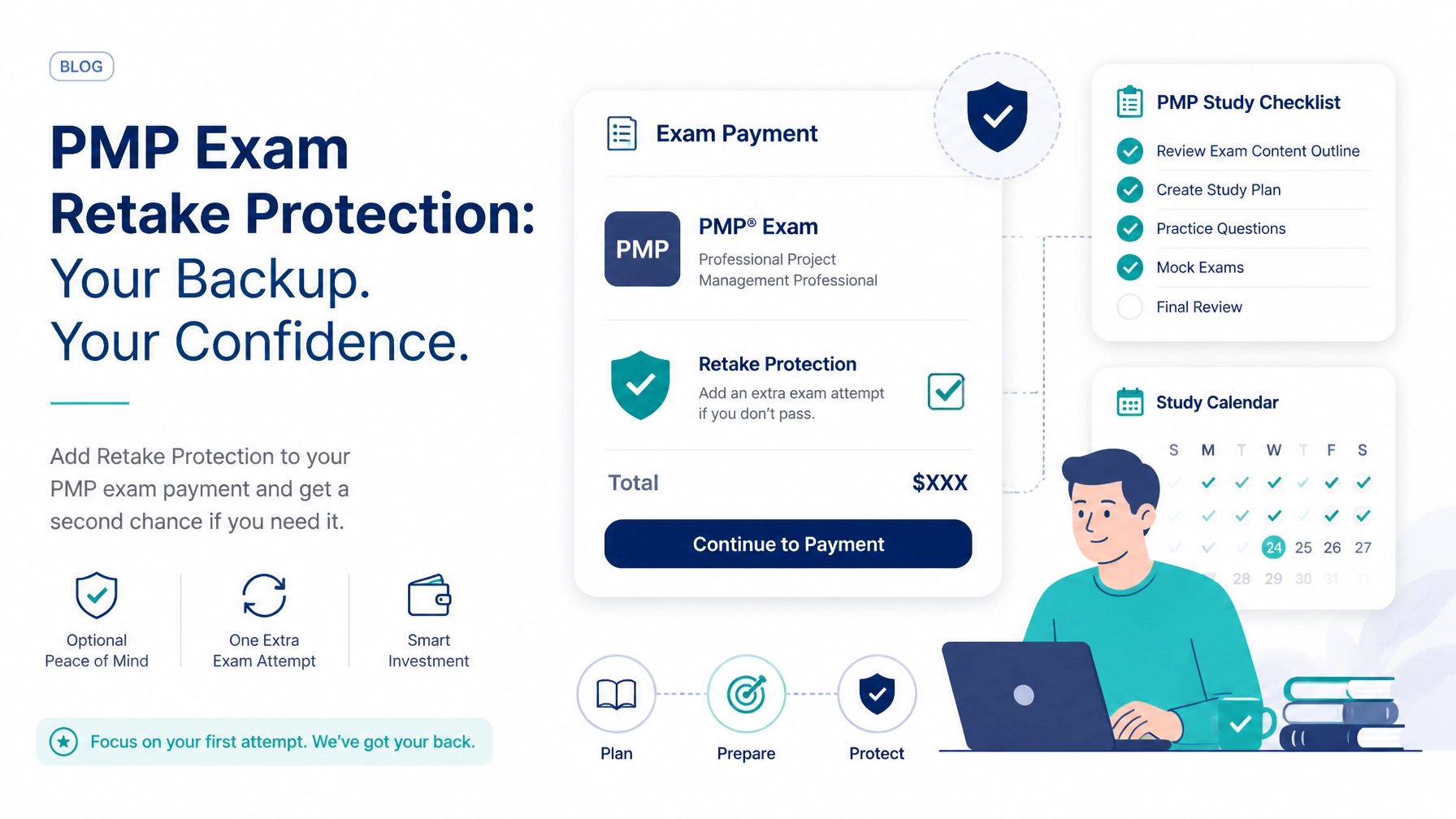
    PMI now displays an optional PMP Exam Retake Protection product in connection with PMP exam payment.

    The option matters because it may provide candidates with one additional exam attempt if they do not pass their first attempt. That can help some candidates manage part of the financial risk associated with an unsuccessful first attempt.

    PMI’s existing PMP retake policy also still matters here. PMI currently states that candidates may take the PMP exam up to three times within their one-year eligibility period. Based on the information currently displayed, Exam Retake Protection does not appear to replace that existing policy. It appears to be a separate payment or protection option connected to exam purchase.

    This is a payment option connected to the PMI PMP exam. It is not a change to the PMP exam structure, content outline, question count, or domain weighting. Candidates should continue preparing for the exam they are scheduled to take and should review the current PMP certification information from PMI.

    The information currently confirmed comes from PMI’s displayed candidate page, product page, and checkout process. Some purchasing and eligibility details have not yet been clearly published for every candidate or location.

    What Is PMP Exam Retake Protection?

    PMP Exam Retake Protection is an optional product that candidates may be offered when purchasing their PMP exam.

    Based on PMI’s displayed wording, the protection provides:

    • One retake
    • Coverage if the candidate does not pass on the first attempt
    • An option purchased with the exam

    In practical terms, a candidate may choose to pay an additional amount during the exam purchase process. If the candidate does not pass the first attempt, PMI states that the protection provides one retake.

    The product is separate from exam preparation. It does not increase readiness, change the exam questions, or replace the need to study. It is best understood as a possible financial backup connected to the first exam attempt.

    How Does PMP Retake Protection Work?

    PMI’s candidate page displays the wording:

    “Pay for Your PMP® Exam with Retake Protection”

    PMI describes the option as providing:

    “one retake if you don’t pass on your first attempt.”

    PMI also states that the protection is purchased with the exam and that it:

    “will automatically apply to your exam.”

    These statements confirm the basic operation shown by PMI:

    1. The candidate purchases the protection with the PMP exam.
    2. The candidate takes the first exam attempt.
    3. If the candidate does not pass the first attempt, the protection provides one retake.
    4. PMI says the protection automatically applies to the exam after purchase.

    The wording above describes the information currently displayed by PMI. It does not confirm additional terms such as the exact scheduling process, the timing of the retake, or the conditions that may apply in a specific account.

    Candidates should review the terms shown in their own PMI account before submitting payment.

    Conceptual three-step flow showing exam payment, first attempt, and one retake if unsuccessful

    Conceptual illustration. This is not a PMI checkout screenshot.

    How Much Does PMP Exam Retake Protection Cost?

    A separate PMI product page identifies the product as:

    Project Management Professional (PMP)® Exam Retake Protection

    The displayed prices are:

    • PMI Member Price: USD $45
    • Full Price: USD $61

    These amounts are the prices displayed on the PMI product page referenced for this article. They should not be treated as a universal price for every candidate.

    Your PMP exam cost may depend on factors such as:

    • PMI membership status
    • Location
    • Currency
    • Applicable taxes
    • The prices shown in your PMI account
    • Other purchasing circumstances

    Before paying, review the product name, price, currency, and terms shown in your own checkout process. If the amount in your account differs from the prices above, rely on the current information presented by PMI for your purchase.

    Example of What the Checkout Looks Like

    One captured PMI checkout example displayed the following items:

    This is one captured example only. It should not be treated as the standard PMP exam fee or a universal PMI price point.

    Checkout item Displayed amount
    PMP Exam $425
    PMP Exam Retake Protection $45
    Estimated total $470

    This example shows how the protection may appear as a separate line item alongside the exam.

    The $425 PMP exam price is not a universal current exam price. It is an example from the captured checkout. Exam pricing may vary based on membership, location, taxes, currency, or other circumstances.

    The displayed $470 total also should not be treated as a standard total for every PMP candidate. Use your own PMI checkout page as the source for the amount that applies to your account.

    Does This Mean You Should Worry Less About Passing?

    PMP Exam Retake Protection may reduce some financial pressure around the first attempt. However, the main goal remains unchanged:

    Prepare to pass the PMP exam the first time.

    Protection is a backup. It is not a replacement for preparation.

    The PMP exam requires candidates to apply project management concepts to situations involving people, process, and business environment responsibilities. Candidates still need to understand the exam content, practice decision-making, manage time, and identify areas that require additional review.

    A protected retake may provide another opportunity. It does not make the first attempt less important, and it does not guarantee that a second attempt will be successful.

    Who Might Consider It?

    The option may be worth considering for candidates who want additional financial protection around the first exam attempt.

    Possible situations include:

    • Candidates concerned about exam cost: The additional fee may seem reasonable to someone who wants to limit the cost of an unsuccessful first attempt.
    • Candidates who value peace of mind: Knowing that one retake is included may make the purchase decision feel more manageable.
    • Candidates comparing total costs: The separate protection fee can be considered alongside the overall PMP exam cost and preparation budget.

    Not every candidate will reach the same conclusion. Some well-prepared candidates may decide that they do not need PMP exam protection. Others may prefer to purchase the option because the additional financial coverage fits their circumstances.

    The decision should be based on the price and terms shown in your PMI account, your preparation level, and your own tolerance for the cost of an unsuccessful first attempt.

    What We Still Don’t Know

    PMI’s displayed information confirms the existence of the product, its optional association with exam payment, its displayed prices, and the provision of one retake after an unsuccessful first attempt.

    Other details remain unclear from the information currently available publicly. Candidates should not assume that the following terms are the same in every account or location:

    • Geographic availability
    • Whether the product can be purchased separately after the exam has already been purchased
    • Detailed exclusions
    • Refund rules
    • Transfer rules
    • Expiration details
    • Other eligibility requirements
    • What happens after the protected second attempt

    The available information also does not establish a universal set of terms for every country, currency, membership type, or candidate situation.

    Before purchasing, review the terms presented during your own PMI checkout process. If an important condition is not clear, contact PMI directly before submitting payment.

    PMP Exam Retake Protection vs. Exam Preparation

    PMP retake protection addresses one part of the exam decision: the financial risk associated with an unsuccessful first attempt.

    Preparation addresses the exam itself.

    A structured preparation process can help you:

    • Practice realistic project management questions.
    • Review explanations after each answer.
    • Track performance across relevant topics.
    • Identify weak areas before test day.
    • Build pacing skills through timed sessions.
    • Continue unfinished study sessions across devices.
    • Focus review time on the areas that need attention.

    Candidates preparing for the PMP exam 2026 should use current exam information and practice with questions that require applied judgment. Scores alone are not enough. Review the reasoning behind each answer and look for patterns in the areas where accuracy or confidence is lower.

    PM Quest Prep supports this workflow with practice questions, realistic mock exams, timed quizzes, targeted review, explanations, and progress analytics. The platform is available on the web, iPhone, and Android.

    PM Quest Prep performance analytics showing domain performance, accuracy, study activity, achievements, and exam readiness

    PM Quest Prep performance analytics help candidates review accuracy, domain performance, study activity, and exam readiness.

    Start preparing on the web at https://app.pmquestprep.com.

    Final Takeaway

    PMP candidates now have another option for managing some of the financial risk associated with an unsuccessful first attempt.

    PMI’s displayed information confirms that PMP Exam Retake Protection is an optional product associated with exam payment. PMI states that it provides one retake if the candidate does not pass on the first attempt and that the protection automatically applies to the exam after purchase.

    The displayed price is USD $45 for PMI members and USD $61 at the full price. A captured checkout example showed a $425 PMP exam line item, $45 for the protection, and an estimated total of $470. These amounts may not apply universally.

    Review the terms and price shown in your own PMI account. Then make a decision based on your circumstances.

    Whether you purchase the protection or not, preparation should remain focused on passing the PMP exam the first time.

    Disclaimer

    PM Quest Prep is an independent educational platform. It is not affiliated with, sponsored by, endorsed by, or approved by PMI®. It does not provide official PMI exam questions. PMP®, PMI®, PMBOK®, and related marks belong to Project Management Institute, Inc.
    Suggested sources

  • PMP vs CAPM in 2026: Which Certification Should You Pursue First?

    PMP vs CAPM in 2026: Which Certification Should You Pursue First?

    If you’re comparing PMP vs CAPM in 2026, the right choice depends mainly on your project experience, education, career direction, and readiness for each exam.

    The CAPM is designed for people building foundational project management knowledge. The PMP is designed for professionals who already lead and direct projects.

    You do not need to earn CAPM before applying for PMP. If you already meet PMI’s PMP eligibility requirements, applying directly for PMP may be the more practical route. If you are still building experience, CAPM can provide a structured starting point.

    Quick answer: Choose CAPM if you are entering project management or do not yet meet PMP experience requirements. Choose PMP if you already have the required project leadership experience and training.

    PMP vs CAPM: Quick comparison

    Category CAPM® PMP®
    Best suited for Aspiring and early-career project professionals Experienced project professionals
    Professional project leadership experience Not required Required
    Education requirement High school diploma or global equivalent Secondary, post-secondary, bachelor’s, or GAC-accredited degree path
    Project management education 23 contact hours 35 hours, unless an active CAPM credential provides the training credit
    Exam length 150 questions in 180 minutes 180 questions in 240 minutes
    Exam emphasis Fundamentals, predictive, agile, and business analysis People, process, business environment, and applied judgment
    Typical next step Build experience and continue professional development Maintain the credential and continue professional development

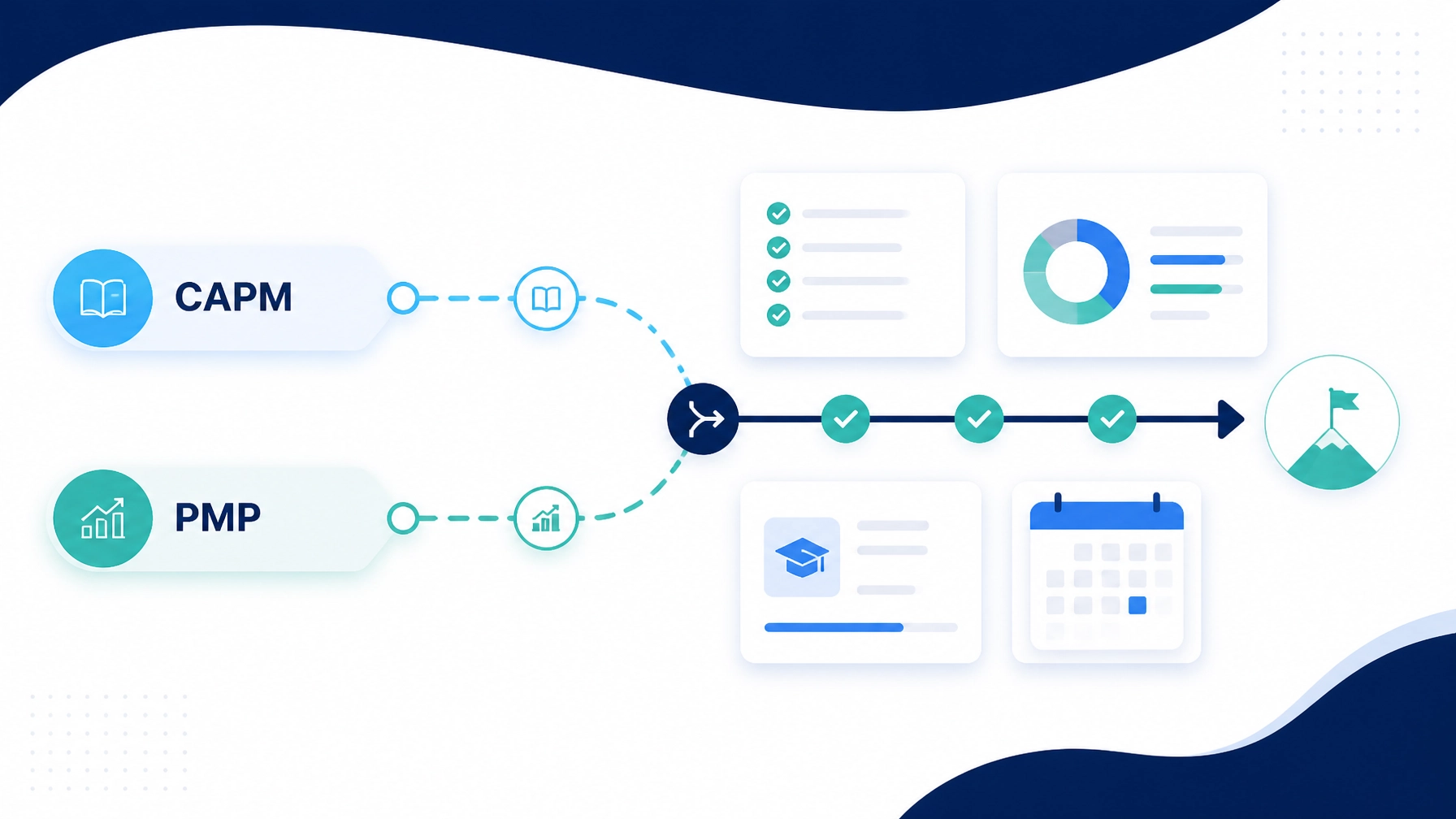
    Infographic-style comparison of CAPM as a project management foundation and PMP as a project leadership path

    When CAPM is the better first choice

    CAPM is generally the better starting point when you want to enter project management but do not yet have the experience required for PMP.

    Choose CAPM if you:

    • Are a student, recent graduate, or career changer.
    • Work as a project coordinator, project analyst, or PMO support professional.
    • Contribute to project work but do not lead and direct projects.
    • Want to build a structured understanding of project management terminology.
    • Need a certification aligned with predictive, agile, and business analysis concepts.
    • Are still accumulating the professional experience needed for PMP.

    CAPM does not require professional project leadership experience. That makes it accessible to learners who are developing their project management foundation through education, project support work, or related professional responsibilities.

    The credential can also help you organize the concepts you encounter at work. You can study project roles, stakeholders, scope, schedule, risk, quality, delivery approaches, and requirements before taking on larger leadership responsibilities.

    CAPM is not a mandatory step toward PMP. It is an optional foundation that may be useful when you are not yet PMP-eligible.

    When PMP is the better first choice

    PMP is generally the better choice when you already meet PMI’s experience and education requirements.

    Choose PMP if you:

    • Have led and directed projects in a professional setting.
    • Meet the required experience period for your education path.
    • Want to validate project leadership capability.
    • Work as a project manager, delivery lead, implementation manager, or similar professional.
    • Are prepared for scenario-based questions that require applied judgment.
    • Want to focus your preparation on people, process, and business environment responsibilities.

    The July 2026 PMP Examination Content Outline describes an exam built around the work of professionals who lead and direct projects. The exam tests more than terminology recall. It asks candidates to apply project management concepts to realistic situations and select an appropriate course of action.

    If you meet the requirements, taking CAPM first may add an additional application, exam, and maintenance cycle without being necessary for PMP eligibility. Review your experience carefully before making that decision.

    PMP and CAPM eligibility requirements in 2026

    CAPM eligibility

    To apply for the CAPM exam, you need:

    • A high school diploma or global equivalent.
    • 23 contact hours of project management education completed before the exam.

    You do not need professional project leadership experience for CAPM.

    The education may come from eligible courses, training programs, academic instruction, or other qualifying providers. Keep records of completed education in case PMI requests documentation.

    PMP eligibility

    The July 2026 PMP Examination Content Outline lists several education and experience paths. Your project leadership experience must be professional, non-overlapping, and earned within the past 10 years before submitting your application.

    Education path Required project leadership experience
    Secondary school or high school diploma, or global equivalent 60 months
    Recognized associate-level, higher-certificate, or advanced technical/vocational qualification mapped to the applicable post-secondary level 48 months
    Bachelor’s degree or higher, or recognized equivalent 36 months
    Bachelor’s or postgraduate degree from a PMI Global Accreditation Center-accredited program 24 months

    PMP applicants must also complete 35 hours of project management training aligned with the PMP Examination Content Outline.

    An active CAPM credential provides a 35-training-hour credit toward the PMP education requirement. This does not remove the PMP experience requirement. You must still document the required months of professional project leadership experience for your education path.

    PMI may audit applications. Maintain accurate records of your education, project dates, responsibilities, and organizations.

    Exam structure comparison

    CAPM exam structure

    The CAPM exam includes:

    • 150 total questions
    • 135 scored questions
    • 15 pretest questions that are not scored
    • 180 minutes, or three hours
    • One 10-minute break after questions 1–75

    The CAPM content is divided into four domains:

    CAPM domain Exam weighting
    Project Management Fundamentals and Core Concepts 36%
    Predictive, Plan-Based Methodologies 17%
    Agile Frameworks/Methodologies 20%
    Business Analysis Frameworks 27%

    The domain distribution creates a balanced foundation. CAPM preparation should not focus only on traditional project planning. Agile methods and business analysis together represent a significant portion of the exam.

    PMP exam structure

    The July 2026 PMP exam includes:

    • 180 total questions
    • 170 scored questions
    • 10 pretest questions that are not scored
    • 240 minutes, or four hours
    • Two 10-minute breaks

    The PMP domains are:

    PMP domain Exam weighting
    People 33%
    Process 41%
    Business Environment 26%

    Predictive approaches represent approximately 40% of the exam. Adaptive/agile and hybrid approaches represent approximately 60%. These approaches are integrated across the three domains rather than separated into individual sections.

    This structure means PMP preparation should include leadership, stakeholder engagement, integrated planning, value delivery, governance, compliance, risk, change, impediments, and organizational context.

    How CAPM can support a path toward PMP

    A common progression looks like this:

    1. Build foundational knowledge.
      Study core project management concepts and complete the CAPM education requirement.
    2. Earn CAPM if it supports your career plan.
      Use the credential to demonstrate foundational knowledge while pursuing project coordinator, PMO, analyst, or project team roles.
    3. Track professional project experience.
      Record project dates, responsibilities, stakeholders, outcomes, and leadership activities. Avoid counting overlapping months twice.
    4. Develop leadership responsibility.
      Look for opportunities to coordinate delivery, manage risks and issues, support stakeholders, guide teams, and contribute to project decisions.
    5. Review PMP eligibility.
      Once you meet the required experience path, verify your education and training records before applying.
    6. Prepare for applied PMP questions.
      Shift from definition-based study toward scenario analysis, judgment, and selecting actions that support project and stakeholder outcomes.

    An active CAPM credential can provide the PMP training-hour credit, but it does not guarantee PMP eligibility or exam success.

    A practical decision checklist

    Use these questions to choose your next step:

    Start with CAPM when:

    • You do not meet any PMP experience path.
    • You want to enter project management.
    • You need a structured foundation.
    • Your current work supports projects but does not involve leading and directing them.
    • You want to study fundamentals, predictive methods, agile approaches, and business analysis.

    Pursue PMP when:

    • You meet the required professional project leadership experience.
    • You have the required education or an active CAPM credential for the training-hour credit.
    • You are ready for a longer exam focused on applied judgment.
    • Your career direction includes project leadership and delivery responsibility.
    • You can document your experience accurately.

    The decision is less about which certification is “better.” It is about which certification matches your current stage.

    Prepare with a structured study workflow

    Once you choose an exam, use a study process that shows where to focus. Practice questions can reinforce concepts, while timed exams help you manage pacing across a long testing session.

    PM Quest Prep supports PMP and CAPM preparation through web, iPhone, and Android access. The platform includes practice questions, timed exams, targeted review, flashcards, glossary training, progress analytics, and AI-powered study assistance for educational use. Users can track weak areas, continue unfinished sessions, and organize study goals across devices.

    Start preparing at PM Quest Prep.

    PM Quest Prep is an independent study platform. It is not affiliated with, sponsored by, endorsed by, or approved by Project Management Institute, Inc. PMI®, PMP®, and CAPM® are marks of Project Management Institute, Inc.

    Official sources and next steps

    Before applying, confirm the latest requirements directly with PMI:

    Choose CAPM when you need a foundation. Choose PMP when your experience supports the application. Then build a study plan that matches the exam structure, your available time, and the areas where you need focused practice.