The PMP® certification exam changed in July 2026. If you’re searching for the PMP exam changes 2026, the biggest updates affect domain weighting, question formats, exam emphasis, and how candidates should prepare. The updated exam reflects how project professionals work today across predictive, adaptive/agile, and hybrid environments.
The biggest shift is not simply a new list of topics. The updated exam places stronger emphasis on applied judgment, governance, value delivery, strategic alignment, and current professional considerations such as sustainability and artificial intelligence.
This guide explains the current PMP exam structure, domain weightings, question formats, and the study strategy candidates should use now.
Source note: This article follows the PMP Examination Content Outline – July 2026, which is the primary factual authority for the current exam blueprint.
The current PMP exam structure
The 2026 PMP exam includes:
- 180 total questions
- 170 scored questions
- 10 pretest questions
- 240 minutes of exam time
- Two 10-minute breaks
The 10 pretest questions are unscored and can appear randomly throughout the exam. They help PMI evaluate questions for possible future use. You will not know which questions are pretest items, so every question should receive the same level of attention.
The exam may include several item types:
- Multiple-choice questions with one correct response
- Multiple-response questions with more than one correct response
- Drag-and-drop and matching items
- Pull-down list questions
- Point-and-click questions on computer-based testing
- Case or scenario questions
- Graphic-based questions
- Practicum or hands-on testing that may involve tools, data, or case studies
The updated ECO specifically identifies case or scenario questions and graphic-based questions as new formats. These formats require you to interpret information and apply project management judgment rather than recall a definition.
The first break occurs after the case-study section. The second break occurs approximately midway through the independent question portion. Once you review your answers and begin a break, you cannot return to questions from the previous section.
The three PMP domains and their 2026 weightings
The current exam is organized into three domains.
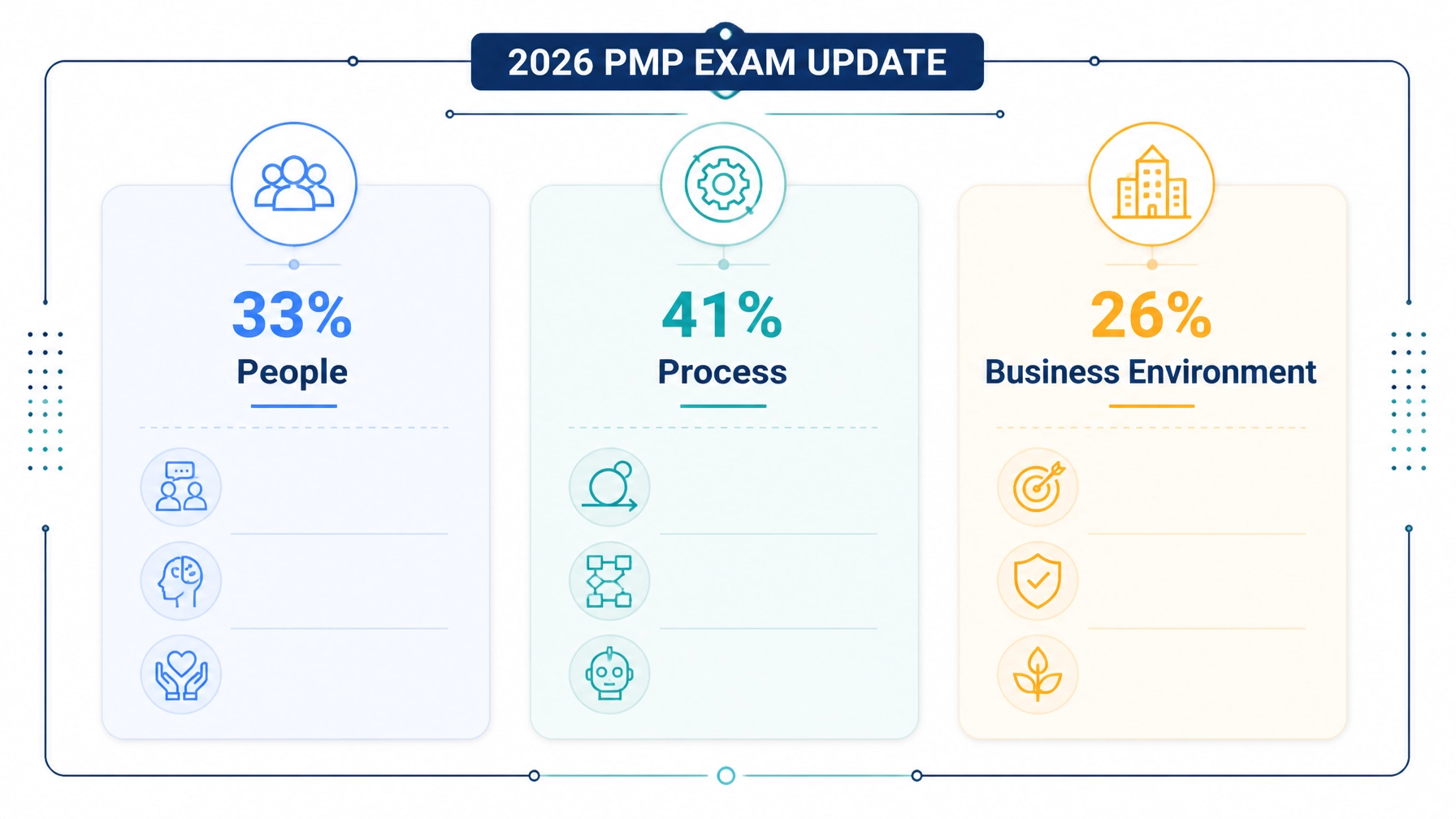
| Domain | Weighting |
|---|---|
| People | 33% |
| Process | 41% |
| Business Environment | 26% |
The percentages represent the proportion of exam items associated with each domain. They should guide how you allocate study time.
Domain I: People : 33%
The People domain evaluates how you lead teams, engage stakeholders, align expectations, and support communication.
The domain includes tasks related to:
- Developing a common vision
- Managing conflict
- Leading the project team
- Engaging stakeholders
- Aligning stakeholder expectations
- Managing stakeholder expectations
- Supporting knowledge transfer
- Planning and managing communication
The updated outline places practical emphasis on shared vision, trust, stakeholder alignment, team empowerment, tailored communication, and knowledge transfer.
Prepare to evaluate situations from several perspectives. The best answer may depend on the source of a conflict, the needs of a stakeholder, the project context, or the team’s level of maturity.
Domain II: Process : 41%
Process remains the largest domain on the 2026 exam. It covers the planning, delivery, monitoring, and closing activities used to manage project work.
Key tasks include:
- Developing an integrated project management plan
- Planning delivery
- Managing project scope
- Ensuring value-based delivery
- Planning and managing resources
- Planning and managing procurement
- Planning and managing finance
- Planning and optimizing quality
- Planning and managing schedule
- Evaluating project status
- Managing project closure
The Process domain is broader than a memorization list. Questions may ask you to choose the next action, interpret project data, select a delivery approach, assess a variation, or determine how to maintain value throughout the project.
Focus on the relationship between planning, execution, measurement, and decision-making.
Domain III: Business Environment : 26%
Business Environment has a significant 26% share of the current exam. It should be part of your core PMP exam preparation, not a final review topic.
The domain includes:
- Defining and establishing project governance
- Planning and managing project compliance
- Managing and controlling changes
- Removing impediments and managing issues
- Planning and managing risk
- Supporting continuous improvement
- Supporting organizational change
- Evaluating external business environment changes
This domain connects project decisions to the organization, customers, regulators, markets, technology, and broader business conditions.
Study how project managers:
- Establish governance rules and escalation paths
- Define success metrics
- Identify compliance requirements
- Assess the consequences of noncompliance
- Manage changes through an appropriate process
- Respond when risks become issues
- Evaluate organizational and external changes
- Connect project outcomes to business needs

Predictive, adaptive/agile, and hybrid approaches appear across the exam
The 2026 ECO does not isolate delivery approaches into separate domains. Predictive, adaptive/agile, and hybrid approaches can appear throughout People, Process, and Business Environment.
The approximate distribution is:
- Predictive: 40%
- Adaptive/agile and hybrid: 60%
The exact number of items for each approach may vary by exam form. The practical takeaway is clear: candidates need to prepare for more than one way of working.
A strong study plan should cover:
- Predictive planning, baselines, dependencies, change control, and formal reporting
- Adaptive/agile prioritization, iteration, feedback, impediment removal, and backlog decisions
- Hybrid environments that combine predictive governance with adaptive delivery practices
Avoid studying agile as a separate chapter that you complete and then leave behind. Agile and hybrid scenarios may involve stakeholder engagement, quality, risk, governance, scope, value, and organizational change.
What are the biggest PMP exam changes in 2026?
1. More real-world alignment
The updated ECO is based on current project management responsibilities and professional practice. PMI states that the exam assesses the ability to apply project management concepts and experience to on-the-job situations.
That means scenario questions may present incomplete information, competing priorities, stakeholder concerns, or changing conditions. You will need to identify the most appropriate response for the situation instead of selecting a definition that sounds familiar.
2. Greater emphasis on governance
Governance is now a clearly defined Business Environment task.
Prepare to understand:
- How governance structures operate
- How rules, policies, and procedures guide decisions
- How to define and use success metrics
- When and how to escalate an issue
- How reporting supports governance
- How project decisions remain aligned with organizational expectations
Governance questions may require you to distinguish between a project-level decision and a decision that requires escalation or organizational approval.
3. Stronger focus on value-based delivery
The Process domain includes a dedicated task for ensuring value-based delivery.
This includes:
- Identifying value with stakeholders
- Prioritizing work based on value and feedback
- Delivering value incrementally where appropriate
- Examining business value throughout the project
- Measuring benefits
- Evaluating delivery options
Do not limit project success to scope, schedule, and budget. The current ECO connects success to stakeholder value and desired outcomes.
4. More strategic and external context
The exam also expects candidates to evaluate the wider environment around a project.
Relevant factors may include:
- Organizational strategy
- Market changes
- Regulation
- Technology
- Geopolitical conditions
- Organizational culture
- Sustainability requirements
- Customer and stakeholder expectations
When reviewing a scenario, ask how the decision affects the project’s intended value and the organization’s broader objectives.
5. AI and sustainability considerations
The updated exam places stronger emphasis on applied judgment, governance, value delivery, strategic alignment, and current professional considerations such as sustainability and artificial intelligence.
This does not mean that every question will test a specific AI tool or sustainability framework. It means you should understand how these considerations can affect project decisions, risks, compliance, quality, data, resources, and long-term outcomes.
Study the decision-making principles behind these topics. Focus on responsible use, project context, stakeholder impact, compliance, and value.
How to adjust your PMP study strategy
Shift from memorization to situational judgment
Memorization still has a role. You need to understand terminology, concepts, processes, artifacts, and approaches.
However, your main practice should involve questions that ask:
- What should the project manager do next?
- What is the best response?
- Which action should happen first?
- Who should be engaged?
- What information should be reviewed?
- Which approach best fits the situation?
After answering a question, explain why the correct option is appropriate and why the other options are less suitable.
Give Business Environment consistent study time
Include Business Environment in your weekly schedule from the beginning.
Build review sessions around:
- Governance and escalation
- Compliance
- Change control
- Risk and issues
- Organizational change
- External business conditions
- Continuous improvement
- Strategic alignment and value

Practice integrated agile and hybrid scenarios
Use mixed practice sets rather than studying predictive and agile topics in isolation.
For each scenario, identify:
- The delivery approach
- The project phase or context
- The stakeholder or team concern
- The information available
- The value or outcome at risk
- The most appropriate next action
This process helps you apply the approach instead of relying on keywords.
Use realistic simulations
The current question formats make realistic practice especially important. Include timed sessions with:
- Longer case scenarios
- Charts and visual data
- Multiple-response items
- Matching and drag-and-drop questions
- Predictive, agile, and hybrid situations
- Governance, value, risk, and compliance decisions
Review accuracy and reasoning, not just your final score. Track the domains and task areas where you need additional practice.
How PMBOK 8 fits into 2026 PMP preparation
If PMBOK® Guide – Eighth Edition is part of your study materials, use it as a reference alongside the current ECO.
The PMP Exam Content Outline should be your primary blueprint for what the exam assesses. PMBOK® Guide – Eighth Edition can support your understanding, but candidates still need to prepare for the domains, tasks, approaches, and applied scenarios defined by the current ECO.
Your study plan should therefore use the July 2026 ECO as the blueprint. Use PMBOK 8 and other reputable resources to build understanding, then confirm that your practice covers the current domains, tasks, question types, and delivery approaches.
Materials aligned only to an older exam outline may not reflect the current balance of People, Process, and Business Environment.
A practical next step
Start by comparing your current study plan with the 2026 ECO.
Check that you are:
- Allocating time according to the 33/41/26 domain weighting
- Studying predictive, adaptive/agile, and hybrid approaches
- Practicing situational judgment
- Reviewing governance and value delivery
- Including sustainability, AI, compliance, and external change
- Using timed practice and realistic simulations
- Tracking weak areas and reviewing them consistently
PM Quest Prep supports current PMP® preparation with practice questions, timed exams, targeted review, progress analytics, and interactive study modes. The platform is available on the web, iPhone, and Android, so you can continue sessions across devices and organize your preparation around your available study time.
Ready to practice for the current PMP exam?
Study on the web: https://app.pmquestprep.com
PM Quest Prep is also available on iPhone and Android.
PM Quest Prep is an independent educational platform. It is not affiliated with, sponsored by, endorsed by, or approved by PMI®. It does not provide official PMI questions or PMI endorsement. Its practice questions and AI-powered study tools are provided for educational purposes and do not guarantee certification results.
The July 2026 PMP exam rewards preparation that reflects real project work. Use the current ECO to organize your study, practice decisions in context, and track progress across all three domains.