Tag: CAPM exam prep

  • CAPM Practice Questions: How to Study Across All Four Exam Domains

    CAPM Practice Questions: How to Study Across All Four Exam Domains

    CAPM practice questions are most useful when they help you make a study decision.

    A mixed question bank can show whether you answered correctly. It may not show why you are struggling or which part of the CAPM exam content needs more attention. A better approach is to use practice questions across the four current CAPM exam domains, review your results by domain, and adjust your next study session based on the pattern.

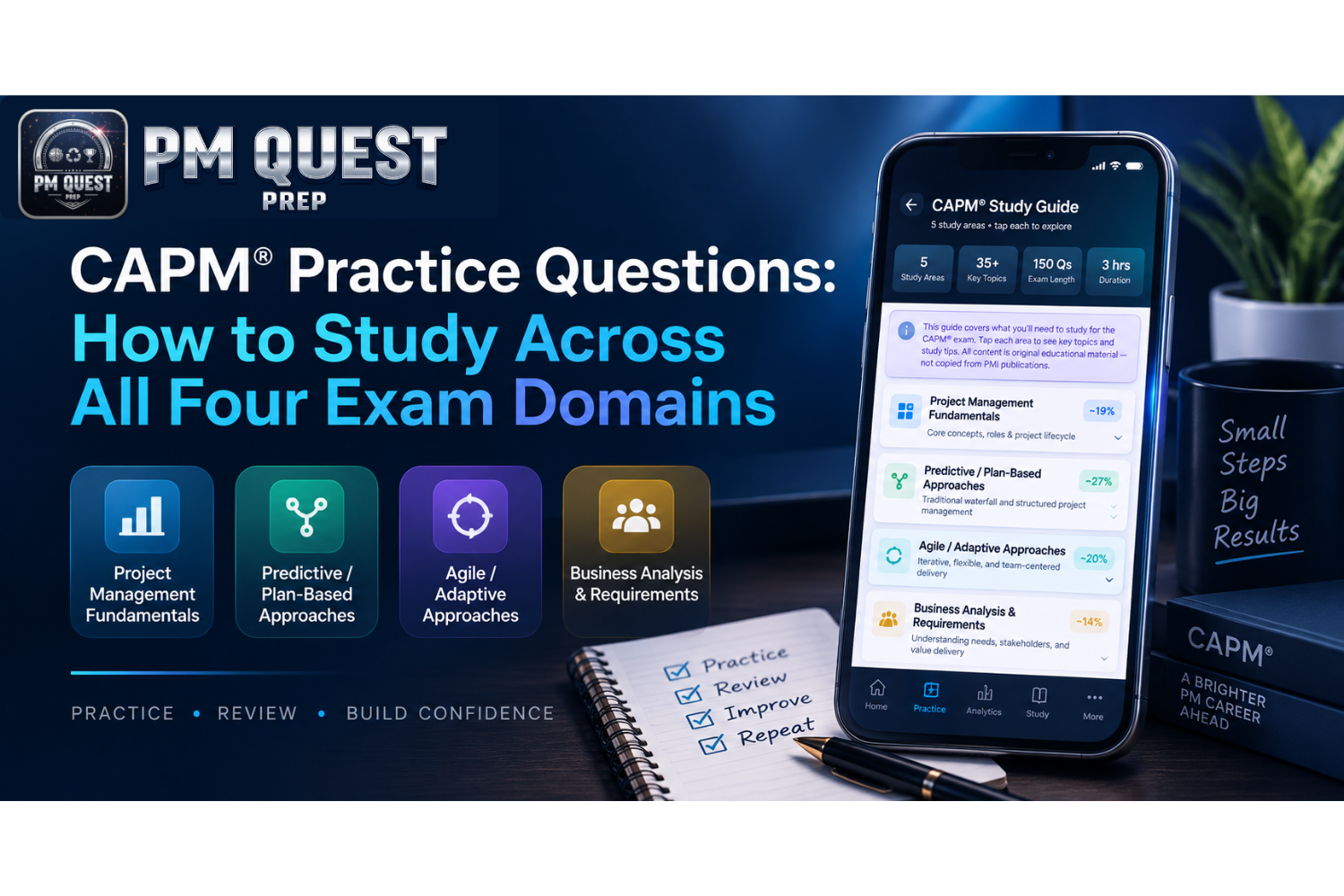
    The current PMI CAPM Examination Content Outline (ECO) identifies these domains:

    • Project Management Fundamentals and Core Concepts: 36%
    • Predictive, Plan-Based Methodologies: 17%
    • Agile Frameworks/Methodologies: 20%
    • Business Analysis Frameworks: 27%

    These percentages describe the proportion of items assigned to each domain on the examination. They do not prescribe how many hours you must study, how many questions you must complete, or how you must divide your personal study schedule.

    What the Four CAPM Domain Percentages Mean

    The four percentages give you a useful map. They help you see the relative coverage of the exam and organize your practice.

    They do not mean that every question is isolated inside one domain. PMI’s ECO notes that today’s project team members work in a variety of project environments and use different project approaches. Accordingly, the CAPM exam reflects approaches across the value-delivery spectrum.

    This matters when you build a study plan. You should use the percentages as a starting point, then combine them with your own performance.

    A candidate who performs well in Fundamentals may need more review in Business Analysis. Another candidate may understand business analysis concepts but need more practice interpreting predictive project controls. The best next step depends on the evidence from practice.

    How to Use Practice Questions Across All Four Domains

    Start with mixed practice so you can see your current profile. Then use domain-focused practice to investigate specific weaknesses.

    For each practice session:

    1. Identify the domain.
      Record whether the question relates mainly to Fundamentals, Predictive, Agile, or Business Analysis.
    2. Answer before checking the explanation.
      Treat the question as a reasoning exercise, not as a reading exercise.
    3. Mark uncertain answers.
      A correct answer based on guessing is still useful review data.
    4. Review the reason for the result.
      Look for a concept gap, a reading error, a reasoning problem, or confusion between similar terms.
    5. Choose the next study action.
      Revisit a concept, practice a related task, review an explanation, or retest later.

    The goal is not to complete a large number of questions without reflection. The goal is to turn each question into information about what to practice next.

    Domain 1: Project Management Fundamentals and Core Concepts

    At 36%, Project Management Fundamentals and Core Concepts is the largest CAPM domain. The ECO broadly covers project life cycles and processes, planning, roles and responsibilities, planned strategies and frameworks, and common problem-solving tools.

    What you should recognize

    Practice questions in this domain may ask you to distinguish between:

    • A project, program, portfolio, and operations
    • Predictive and adaptive approaches
    • Risks, issues, assumptions, and constraints
    • Project management plans and product management plans
    • Milestones and task durations
    • Project manager, sponsor, and team responsibilities
    • Leadership and management
    • Communication, risk, and other planned strategies

    The ECO also includes project initiation, benefit planning, project closure, transitions, emotional intelligence, and the use of tools such as focus groups, standup meetings, and brainstorming.

    These topics are not simply vocabulary items. You may need to recognize how a concept applies in a practical situation.

    How practice questions reveal weaknesses

    If you frequently confuse an issue with a risk, record the distinction and write a short example of each. If you select the wrong stakeholder or project role, review the responsibilities connected to each role.

    Pay attention to repeated patterns. For example, you may know the definition of a stakeholder register but hesitate when a question asks how to use it in a situation. That suggests you need application practice, not only more definitions.

    Common mistakes to avoid

    • Treating every project problem as a risk
    • Memorizing terms without understanding how they are used
    • Assuming the project manager owns every decision
    • Ignoring the difference between leadership and management
    • Reviewing only incorrect answers and skipping uncertain correct answers

    Fundamentals support the rest of the exam, so use this domain to strengthen your project management vocabulary and decision-making foundation.

    Domain 2: Predictive, Plan-Based Methodologies

    Predictive, Plan-Based Methodologies represents 17% of the current ECO. The domain covers when a predictive approach is appropriate, planning and scheduling, project controls, and artifacts used in predictive projects.

    What you should recognize

    The ECO includes areas such as:

    • Suitability of a predictive approach
    • Activities within project processes
    • Project management plan schedules
    • Work breakdown structures and work packages
    • Critical path methods
    • Schedule and cost variance calculations
    • Quality and integration management plans
    • Predictive project controls and artifacts

    Practice questions may require you to identify the appropriate planning or control activity. They may also require you to interpret a calculation or connect a project document to its purpose.

    How practice questions reveal weaknesses

    Separate calculation errors from interpretation errors.

    If you make a calculation mistake, check whether you used the correct information and followed the correct sequence. If the calculation is correct but your conclusion is wrong, review what the result means in the project situation.

    For planning questions, ask what the project team is trying to establish or control. A question about a work package, schedule, or quality plan may test the purpose of the item rather than its definition alone.

    Common mistakes to avoid

    • Focusing only on calculations
    • Memorizing formulas without interpreting results
    • Confusing a work breakdown structure with a schedule
    • Assuming predictive planning is appropriate for every project
    • Treating every predictive question as a document-identification question

    Because this domain has the smallest percentage, some candidates give it too little attention. That can be a mistake if predictive planning is one of your weaker areas.

    Domain 3: Agile Frameworks/Methodologies

    Agile Frameworks/Methodologies represents 20% of the ECO. The domain covers adaptive approaches, iteration planning, adaptive project controls, adaptive plans, and task management.

    What you should recognize

    The ECO includes topics such as:

    • When an adaptive approach may be appropriate
    • Advantages and limitations of adaptive and predictive approaches
    • Organizational conditions that support adaptive work
    • Iterations and logical units of work
    • Adaptive project tracking
    • Adaptive artifacts and controls
    • Components of adaptive plans
    • Differences among approaches such as Scrum, Extreme Programming, Scaled Agile Framework, and Kanban
    • Prioritizing tasks and evaluating success criteria

    Practice questions may ask you to identify an appropriate adaptive approach or interpret how work should be organized within an iteration. They may also test whether you can distinguish between practices associated with different adaptive methodologies.

    How practice questions reveal weaknesses

    When you miss an Agile question, record the framework or approach involved. Then ask:

    • Was the question about adaptive work in general?
    • Was it connected to a specific methodology?
    • Did I confuse an iteration with a broader project phase?
    • Did I understand how the work should be prioritized?
    • Did I choose an answer that sounded agile but did not fit the situation?

    This helps you avoid treating every Agile question as a Scrum question.

    Common mistakes to avoid

    • Memorizing framework terms without understanding their purpose
    • Assuming all adaptive approaches work in exactly the same way
    • Treating adaptive planning as the absence of planning
    • Confusing iteration planning with predictive scheduling
    • Choosing an answer because it contains Agile terminology

    Focus on the situation described in the question. Then determine which approach, artifact, or planning action fits that situation.

    Domain 4: Business Analysis Frameworks

    Business Analysis Frameworks represents 27% of the current ECO. The domain includes business analysis roles, stakeholder communication, requirements gathering, product roadmaps, methodology influence, and validation through product delivery.

    What you should recognize

    Practice questions may cover:

    • Stakeholder roles and responsibilities
    • Internal and external roles
    • Communication channels and tools
    • Requirements gathering techniques
    • User stories, use cases, interviews, surveys, and workshops
    • Requirements traceability matrices and product backlogs
    • Product roadmap components and releases
    • The business analyst’s role in predictive and adaptive approaches
    • Acceptance criteria and readiness for delivery

    The central skill is matching the situation to an appropriate business analysis activity.

    How practice questions reveal weaknesses

    When you miss a question, identify the decision being tested. Was the question asking how to communicate with a stakeholder, gather requirements, organize requirements, or validate a product?

    Then compare the answer choices. Look for the option that best fits the purpose, timing, and situation described. A familiar technique is not automatically the strongest technique.

    For example, if you confuse interviews and workshops, review what each technique is designed to accomplish and when it may be appropriate. If you struggle with traceability, revisit how requirements connect to delivery and validation.

    Common mistakes to avoid

    • Treating all stakeholder communication as the same
    • Memorizing requirements techniques without matching them to situations
    • Confusing a product roadmap with a detailed project schedule
    • Assuming the business analyst and project manager have identical responsibilities
    • Reviewing requirements without considering validation and delivery

    Business Analysis is substantial in the current ECO, but its size does not mean every candidate should spend most of their time there. Your practice results should guide the balance.

    A Practical Review Loop for Missed Questions

    Use the same review process after every domain-focused or mixed practice session.

    1. Identify why you missed the answer

    Classify the result:

    • Concept gap: You did not know or understand the topic.
    • Reading error: You missed a word, condition, or requested action.
    • Reasoning error: You knew the concepts but applied them incorrectly.
    • Term confusion: You mixed up similar roles, documents, or approaches.
    • Uncertain correct answer: You selected the right option but could not explain why.

    This classification is more useful than recording only “wrong.”

    2. Review the underlying concept

    Return to the relevant learning material. Review the definition, purpose, relationship, or process connected to the question.

    Keep the review focused. You do not need to reread every study resource after one missed question.

    3. Understand why the correct answer is stronger

    Ask what evidence in the question supports the correct answer. Then identify why the other options are less suitable.

    The strongest answer is not always the option that sounds most familiar. It is the option that best fits the situation and the concept being tested.

    4. Revisit the weak area

    Look for related questions or connected concepts. If you missed a question about a stakeholder register, you may also need to review stakeholder roles, communication, and planning.

    This step helps you address the underlying weakness rather than one isolated item.

    5. Retest later

    Return to the topic after some time has passed. Use a new question when possible.

    Do not rely on remembering the correct letter or the wording of the original question. The objective is to recognize and apply the concept in a different situation.

    Why the Largest Domain Should Not Receive All Your Attention

    Fundamentals has the largest percentage at 36%. That makes it an important part of the exam, but it does not create a PMI-prescribed study schedule.

    A candidate who already performs consistently in Fundamentals may gain more from reviewing Business Analysis or Predictive topics. A candidate who struggles with Fundamentals may reasonably give it more attention than the percentage alone suggests.

    The percentages describe exam coverage. Your practice results describe your current readiness.

    Use both.

    An Illustrative Way to Balance Practice

    Consider a candidate who reviews a mixed practice session and finds:

    • Strong performance in Fundamentals
    • Frequent mistakes in Business Analysis
    • Inconsistent results in Predictive
    • Moderate performance in Agile

    For the next study cycle, the candidate might:

    • Keep Fundamentals in the rotation for maintenance
    • Give Business Analysis the largest share of focused review
    • Use targeted Predictive practice for planning and control weaknesses
    • Continue Agile practice to maintain familiarity
    • Finish with a mixed session to check whether the changes helped

    This is an illustrative study recommendation, not a PMI-prescribed schedule. The candidate should adjust the balance as performance changes.

    An Optional Weekly Practice Pattern

    A simple weekly pattern can help you avoid studying from one undifferentiated question bank:

    1. Begin with mixed practice to identify current weaknesses.
    2. Choose one or two domains for focused review.
    3. Review every missed and uncertain question.
    4. Revisit the related concepts and tasks.
    5. Retest the weak areas later.
    6. End the cycle with mixed practice across all four domains.

    You can repeat this pattern with shorter or longer sessions based on your available study time. Consistency matters more than forcing every session into the same format.

    Use Domain-Focused Practice More Intentionally

    PM Quest Prep supports CAPM preparation with practice questions, explanations, domain-focused practice, progress tracking, flashcards, and other study tools. Candidates can use the platform on the web, iPhone, and Android to practice by topic, review results, and continue studying across devices.

    PM Quest Prep questions are independently written for educational purposes. They are not official PMI questions.

    Start studying with PM Quest Prep

    Final Takeaway

    CAPM practice questions become more useful when you connect them to the four current exam domains.

    Use the PMI ECO to understand the exam structure:

    • Fundamentals and Core Concepts: 36%
    • Predictive, Plan-Based Methodologies: 17%
    • Agile Frameworks/Methodologies: 20%
    • Business Analysis Frameworks: 27%

    Then use practice results to decide what to review next. Identify why you missed a question, study the underlying concept, compare the answer choices, revisit the weak area, and retest later without relying on memorization.

    The goal is not to treat every question as an isolated score. The goal is to build a clearer view of what you understand, where you need more practice, and how to prepare across all four domains.

    Official PMI Resources

    PM Quest Prep is an independent educational platform. It is not affiliated with, sponsored by, endorsed by, or approved by PMI®. It does not provide official PMI exam questions.

    PMP®, CAPM®, PMI®, PMBOK®, and related marks belong to Project Management Institute, Inc.
  • CAPM Study Plan: A Practical 30-Day Approach

    CAPM Study Plan: A Practical 30-Day Approach

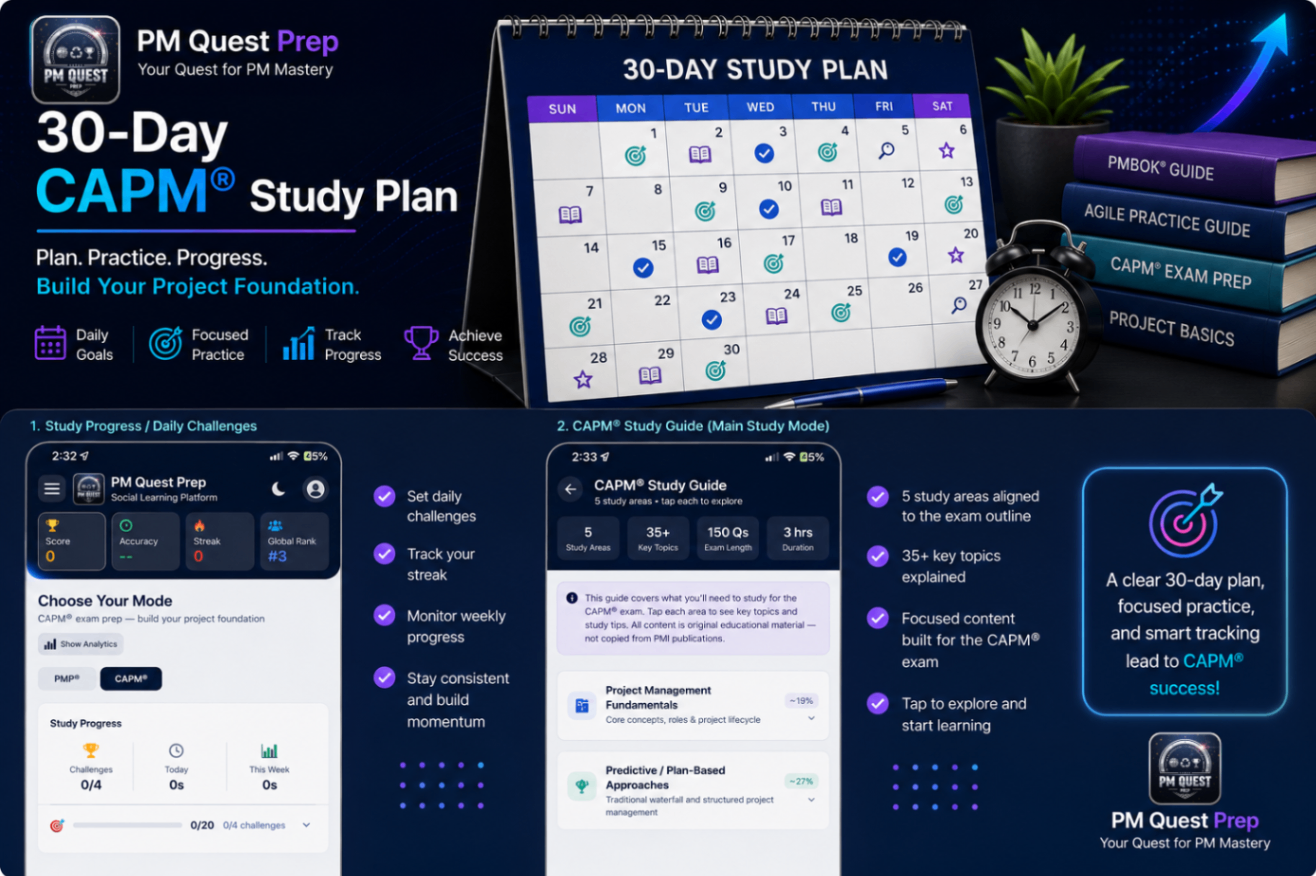
    Preparing for the CAPM® exam while working or studying requires a plan that fits your schedule. A useful plan should help you build foundational knowledge, practice applying concepts, review terminology, and identify weak areas without assuming that every day will be equally productive.

    This 30-day CAPM study plan is a flexible framework. It is not required by PMI, and it is not the only effective way to prepare. Adjust the session length, order, and review time to match your background and availability.

    Start with the current CAPM exam structure

    Before creating your calendar, understand what you are preparing for.

    The current CAPM exam includes 150 questions and has 180 minutes of exam time. PMI’s Examination Content Outline identifies four domains:

    • Project Management Fundamentals and Core Concepts: 36%
    • Predictive, Plan-Based Methodologies: 17%
    • Agile Frameworks/Methodologies: 20%
    • Business Analysis Frameworks: 27%

    The outline states that the exam includes 135 scored questions and 15 unscored pretest questions. It also describes multiple-choice and enhanced item types, including drag-and-drop questions and other scenario-based formats. The exam includes one 10-minute break after questions 1 through 75. Candidates review that section before starting the break, and they cannot return to it after the break begins.

    These domain percentages describe exam coverage. They do not prescribe the exact number of study days or the exact amount of study time you should spend on each domain. Use them as context alongside your background, goals, and recurring weak areas.

    Review the official PMI CAPM certification page and the CAPM Examination Content Outline before you begin. The outline linked above is labeled the 2023 Exam Update. Confirm current eligibility, exam delivery options, scheduling details, and other requirements directly in your PMI account.

    For CAPM certification requirements, PMI currently lists a secondary degree, such as a high school diploma, GED, or global equivalent, plus 23 hours of project management education completed before the exam. Professional project leadership experience is not required under this eligibility route. Confirm your own status and documentation with PMI.

    Choose a realistic daily study format

    A 30-day plan works better when it includes flexible session options.

    Choose one of these formats:

    • Short session: 20 to 30 minutes of flashcards, terminology review, or a small question set.
    • Standard session: 45 to 60 minutes of focused study and practice.
    • Extended session: 75 to 90 minutes, ideally split into two blocks.
    • Weekly review: A longer session used to revisit notes, missed questions, and weak areas.

    If you miss a day, continue with the next planned topic or move that topic to your next review session. Avoid trying to recover by doubling every following session. Consistent study is more practical than an unrealistic daily target.

    Days 1 to 7: Build the foundation

    The first week focuses on Project Management Fundamentals and Core Concepts, the largest CAPM domain by weighting. Use the domain percentages as context, not as a rule for assigning an exact number of study days or an exact amount of study time to each topic. Adjust the plan based on your background, goals, and recurring weak areas.

    Day 1: Set up your study system

    Review the exam domains and tasks. Create a simple tracker with four sections:

    • Topic studied
    • Questions attempted
    • Concepts that need review
    • Next action

    Complete a small, untimed set of baseline practice questions if you have access to one. Use the results to identify starting points, not to predict your exam result.

    Day 2: Learn the project environment

    Review the differences between:

    • Projects, programs, portfolios, and operations
    • Project work and operational work
    • Predictive and adaptive approaches
    • Issues, risks, assumptions, and constraints

    Use active recall. Close your study material and explain each term in your own words. If two concepts sound similar, write a short comparison.

    Day 3: Review life cycles and approaches

    Study project life cycles and the conditions that may support predictive or adaptive work. Focus on why an approach may fit a situation rather than memorizing labels alone.

    Practice identifying the approach that best fits a short scenario. Record the reason for each answer.

    Day 4: Review planning concepts

    Focus on the purpose of common planning elements, including:

    • Scope
    • Schedule
    • Cost
    • Quality
    • Risk
    • Resources
    • Stakeholders
    • Communications

    Review how a risk register and stakeholder register support project work. Practice explaining what information each register contains and when it may be used.

    Day 5: Review roles and responsibilities

    Study the responsibilities of project managers, project sponsors, project teams, and other contributors. Review the difference between leadership and management, along with the role of emotional intelligence in project work.

    Use flashcards for definitions, but also answer application questions. For example, ask what a project manager should do when a team member needs clarification, support, or conflict resolution.

    Day 6: Review execution and problem-solving

    Study project initiation, benefit planning, project closure, and transitions. Review common problem-solving and meeting techniques, including brainstorming, focus groups, and standup meetings.

    Complete a short practice set. Spend more time reviewing the explanations than recording the result.

    Day 7: Complete the first review checkpoint

    Review all notes and questions from Days 1 through 6. Look for repeated confusion.

    Create three lists:

    1. Understood: Concepts you can explain without notes.
    2. Uncertain: Concepts you recognize but cannot explain clearly.
    3. Needs practice: Concepts you understand in theory but miss in scenarios.

    Use the second week to address the third list first.

    Days 8 to 14: Study predictive and adaptive approaches

    This week covers the Predictive, Plan-Based Methodologies and Agile Frameworks/Methodologies domains.

    Day 8: Understand predictive work

    Review when a predictive, plan-based approach may be appropriate. Study process activities, project components, organizational structures, and the relationship between planning and control.

    Practice matching a project situation to a predictive approach and explain your reasoning.

    Day 9: Review WBS, work packages, and schedules

    Study the purpose of a work breakdown structure and work packages. Review how a schedule organizes activities, dependencies, milestones, and durations.

    Do not focus only on definitions. Practice recognizing which project artifact or planning activity fits a given situation.

    Day 10: Review critical path and variance concepts

    Review the purpose of critical path analysis and the relationship between activities and schedule constraints. Study schedule variance and cost variance only at the level supported by the CAPM Examination Content Outline and your chosen study materials.

    Complete a few calculation or interpretation questions if they are part of your preparation materials. Write down the steps used to reach each answer.

    Day 11: Review predictive controls

    Study artifacts and controls used in predictive projects. Review quality management and integration management concepts.

    Complete a short practice set focused on predictive topics. Mark any question where you selected an answer without being able to explain why it was correct.

    Day 12: Understand adaptive work

    Review when an adaptive approach may be appropriate. Compare adaptive and predictive work in terms of planning, delivery, feedback, and change.

    Use scenarios to identify how an adaptive team might respond to changing priorities or evolving requirements.

    Day 13: Review iterations and adaptive artifacts

    Study iterations, task prioritization, adaptive tracking, and common adaptive artifacts. Review the purpose of a product backlog and how work may be organized within an iteration.

    Compare the general characteristics of Scrum, Kanban, Extreme Programming, and other approaches named in your study materials. Focus on distinctions that help you interpret scenarios.

    Day 14: Complete the second review checkpoint

    Review predictive and adaptive questions together. Ask:

    • Can you explain when each approach fits?
    • Can you identify the relevant artifact?
    • Can you distinguish a task, milestone, work package, and iteration?
    • Can you explain the reason behind your answer?

    If not, schedule targeted review for the next week.

    Days 15 to 21: Focus on business analysis and application

    Business Analysis Frameworks represents 27% of the current CAPM exam weighting. This week combines business analysis concepts with mixed application practice.

    Day 15: Review business analysis roles

    Study the responsibilities of business analysts, product managers, product owners, process owners, process managers, stakeholders, and project team members.

    Create a role comparison table. Include the purpose of each role and the type of decision or information the role may support.

    Day 16: Study stakeholder communication

    Review how a business analyst may communicate with stakeholders and teams. Practice selecting an appropriate communication channel for a report, presentation, interview, workshop, or other situation.

    Focus on the purpose of the communication, not only the format.

    Day 17: Review requirements gathering

    Study requirements gathering techniques such as interviews, surveys, workshops, user stories, and use cases. Practice matching the technique to the situation.

    Ask what information is needed, who should provide it, and how the requirement will be documented.

    Day 18: Study traceability and backlogs

    Review the purpose of a requirements traceability matrix and product backlog. Understand how these tools help connect requirements, deliverables, priorities, and validation.

    Use a small example from a project you understand, such as a website update or event plan, to practice tracing a requirement from request to delivery.

    Day 19: Review roadmaps and acceptance criteria

    Study product roadmaps, releases, acceptance criteria, and readiness for delivery. Review how methodology can influence business analysis work in predictive and adaptive environments.

    Complete scenario-based questions that ask whether a product or requirement is ready for the next step.

    Day 20: Complete a mixed application session

    Complete a mixed set of CAPM practice questions covering all four domains. Use a timer only if it helps you focus. The purpose of this session is to identify patterns, not to create a passing prediction.

    For each missed or uncertain question, record the topic, the reason for the mistake, and the next review action.

    Day 21: Complete the third review checkpoint

    Review your tracker and group weak areas into categories:

    • Knowledge gap
    • Terminology confusion
    • Scenario reasoning gap
    • Reading mistake
    • Calculation or process mistake
    • Pacing problem

    This separation matters. Reading mistakes and pacing problems require a different response from a missing definition or misunderstood process.

    Days 22 to 30: Consolidate and check readiness

    The final week should reduce uncertainty, not introduce a large amount of new material.

    Day 22: Review your highest-priority gaps

    Choose two or three topics that appear repeatedly in your tracker. Revisit the learning material, explain each concept without notes, and complete a small targeted question set.

    Day 23: Review Fundamentals

    Return to Project Management Fundamentals and Core Concepts. Revisit life cycles, roles, registers, planning, ethics, closure, and problem-solving.

    Use active recall before rereading. This shows which concepts you can retrieve independently.

    Day 24: Review predictive and adaptive topics

    Compare predictive and adaptive approaches side by side. Review schedules, WBS, critical path, variance, iterations, backlogs, prioritization, and adaptive artifacts.

    Day 25: Review business analysis topics

    Revisit roles, stakeholder communication, requirements gathering, traceability, roadmaps, releases, and acceptance criteria. Complete targeted questions for the areas you have missed more than once.

    Day 26: Complete a timed mixed session

    Complete a timed mixed practice session. Use the experience to evaluate focus, reading speed, and decision-making. Do not treat the result as a PMI readiness threshold. PMI does not publish a simple public percentage that guarantees exam success.

    Day 27: Complete a full simulation

    If your preparation materials include a full simulation, you may choose to use an exam-length session as a preparation strategy. If you do, use a format that reflects the current structure as closely as possible: 150 questions within 180 minutes, with a 10-minute break after the first 75 questions.

    Use this optional session to practice endurance and pacing. It is not a PMI requirement. Follow the instructions of the specific practice provider because practice formats may differ from the official exam.

    Day 28: Review the simulation

    Review every missed and uncertain question. Also review correct answers that required guessing.

    For each question, explain:

    • What the question was testing
    • Why the correct answer fits
    • Why the other options do not fit
    • What clue you missed or used
    • Whether the problem was knowledge, reasoning, reading, or pacing

    Day 29: Create a final review sheet

    Create a concise review sheet containing:

    • Frequently confused terms
    • Key process relationships
    • Predictive and adaptive distinctions
    • Business analysis roles and artifacts
    • Repeated weak areas
    • Questions you still need to verify

    Keep this sheet short. The goal is quick consolidation, not a new textbook.

    Day 30: Use a light study session

    Complete a short recall session and review your final list. Avoid starting several unfamiliar topics at once.

    Confirm current exam details, eligibility information, and scheduling instructions through PMI. Plan your study time around the exam appointment or continue reviewing if you have not selected a date. A flexible final day is more practical than forcing a long session when your concentration is low.

    How to track weak areas

    A simple error log can make your CAPM exam prep more focused.

    These are study examples, not a PMI-prescribed error-log format.

    Example error-log entry: Requirements workshop

    • Domain: Business Analysis
    • What happened: I chose a communication method too quickly.
    • Correct idea: Match the method to the stakeholder need.
    • Next action: Review communication scenarios.

    Example error-log entry: Critical path

    • Domain: Predictive
    • What happened: I used the wrong sequence.
    • Correct idea: Identify the longest dependent path.
    • Next action: Complete targeted practice using the learner’s chosen study materials.

    Example error-log entry: Risk versus issue

    • Domain: Fundamentals
    • What happened: I confused future and current conditions.
    • Correct idea: A risk is uncertain; an issue is present.
    • Next action: Review terminology flashcards.

    Review the log after several sessions. A single missed question may be an isolated mistake. A repeated pattern deserves targeted practice.

    Use practice questions as a learning tool

    Practice questions are most useful when they create a feedback loop:

    1. Attempt the question without checking notes.
    2. Mark your confidence before viewing the answer.
    3. Read the explanation.
    4. Explain the answer in your own words.
    5. Record the reason for the mistake or uncertainty.
    6. Revisit the topic later.
    7. Complete a new question on the same concept.

    This approach helps distinguish genuine understanding from answer recognition.

    Optional study tools

    PM Quest Prep is an independent study platform that supports CAPM preparation with practice questions, explanations, flashcards, progress tracking, and other study tools. You can learn more about PM Quest Prep or access the study platform.

    Use any third-party study tool as a supplement to your preparation. It does not replace PMI’s official certification information, application instructions, or examination policies.

    Final checklist

    Before you consider your 30-day plan complete, check whether you can:

    • Explain the four CAPM exam domains.
    • Describe core project management terms without relying only on recognition.
    • Compare predictive and adaptive approaches.
    • Identify common project and business analysis artifacts.
    • Apply terminology to short scenarios.
    • Explain why an answer is correct.
    • Identify repeated weak areas from more than one practice session.
    • Complete a timed session while maintaining focus.
    • Review a full simulation without relying only on its score.
    • Confirm current CAPM certification requirements and exam details with PMI.

    Progress is easier to evaluate when it is based on repeated evidence, clear explanations, and targeted review. Use this 30-day CAPM study plan as a structure, then adjust it as your practice results show where you need more attention.

    Official sources

    PMI®, CAPM®, PMP®, PMBOK®, and related marks belong to Project Management Institute, Inc.

    PM Quest Prep is an independent educational platform. It is not affiliated with, sponsored by, endorsed by, or approved by PMI®. It does not provide official PMI exam questions.

    Suggested internal links