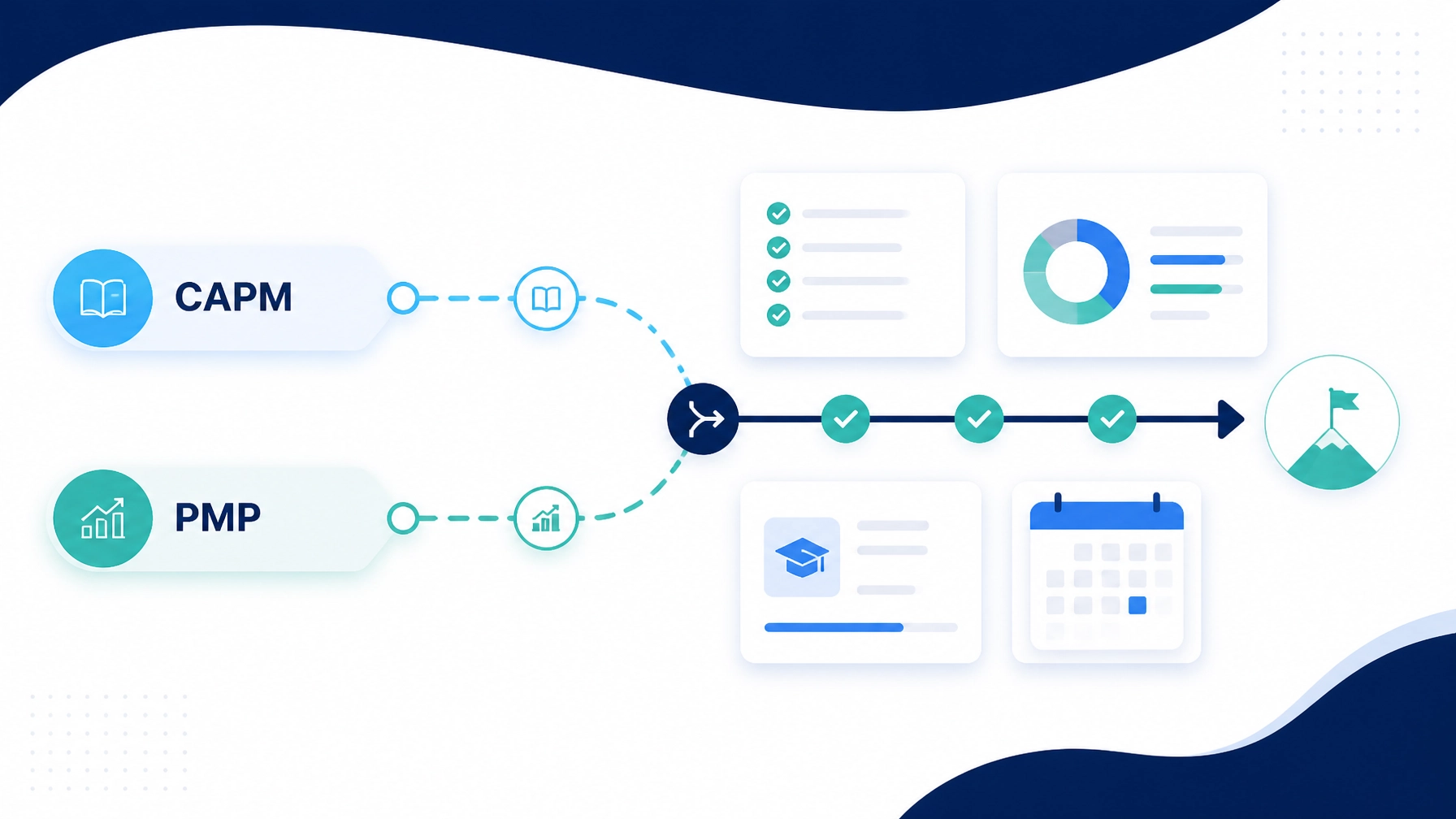
If you’re comparing PMP vs CAPM in 2026, the right choice depends mainly on your project experience, education, career direction, and readiness for each exam.
The CAPM is designed for people building foundational project management knowledge. The PMP is designed for professionals who already lead and direct projects.
You do not need to earn CAPM before applying for PMP. If you already meet PMI’s PMP eligibility requirements, applying directly for PMP may be the more practical route. If you are still building experience, CAPM can provide a structured starting point.
Quick answer: Choose CAPM if you are entering project management or do not yet meet PMP experience requirements. Choose PMP if you already have the required project leadership experience and training.
PMP vs CAPM: Quick comparison
| Category | CAPM® | PMP® |
|---|---|---|
| Best suited for | Aspiring and early-career project professionals | Experienced project professionals |
| Professional project leadership experience | Not required | Required |
| Education requirement | High school diploma or global equivalent | Secondary, post-secondary, bachelor’s, or GAC-accredited degree path |
| Project management education | 23 contact hours | 35 hours, unless an active CAPM credential provides the training credit |
| Exam length | 150 questions in 180 minutes | 180 questions in 240 minutes |
| Exam emphasis | Fundamentals, predictive, agile, and business analysis | People, process, business environment, and applied judgment |
| Typical next step | Build experience and continue professional development | Maintain the credential and continue professional development |

When CAPM is the better first choice
CAPM is generally the better starting point when you want to enter project management but do not yet have the experience required for PMP.
Choose CAPM if you:
- Are a student, recent graduate, or career changer.
- Work as a project coordinator, project analyst, or PMO support professional.
- Contribute to project work but do not lead and direct projects.
- Want to build a structured understanding of project management terminology.
- Need a certification aligned with predictive, agile, and business analysis concepts.
- Are still accumulating the professional experience needed for PMP.
CAPM does not require professional project leadership experience. That makes it accessible to learners who are developing their project management foundation through education, project support work, or related professional responsibilities.
The credential can also help you organize the concepts you encounter at work. You can study project roles, stakeholders, scope, schedule, risk, quality, delivery approaches, and requirements before taking on larger leadership responsibilities.
CAPM is not a mandatory step toward PMP. It is an optional foundation that may be useful when you are not yet PMP-eligible.
When PMP is the better first choice
PMP is generally the better choice when you already meet PMI’s experience and education requirements.
Choose PMP if you:
- Have led and directed projects in a professional setting.
- Meet the required experience period for your education path.
- Want to validate project leadership capability.
- Work as a project manager, delivery lead, implementation manager, or similar professional.
- Are prepared for scenario-based questions that require applied judgment.
- Want to focus your preparation on people, process, and business environment responsibilities.
The July 2026 PMP Examination Content Outline describes an exam built around the work of professionals who lead and direct projects. The exam tests more than terminology recall. It asks candidates to apply project management concepts to realistic situations and select an appropriate course of action.
If you meet the requirements, taking CAPM first may add an additional application, exam, and maintenance cycle without being necessary for PMP eligibility. Review your experience carefully before making that decision.
PMP and CAPM eligibility requirements in 2026
CAPM eligibility
To apply for the CAPM exam, you need:
- A high school diploma or global equivalent.
- 23 contact hours of project management education completed before the exam.
You do not need professional project leadership experience for CAPM.
The education may come from eligible courses, training programs, academic instruction, or other qualifying providers. Keep records of completed education in case PMI requests documentation.
PMP eligibility
The July 2026 PMP Examination Content Outline lists several education and experience paths. Your project leadership experience must be professional, non-overlapping, and earned within the past 10 years before submitting your application.
| Education path | Required project leadership experience |
|---|---|
| Secondary school or high school diploma, or global equivalent | 60 months |
| Recognized associate-level, higher-certificate, or advanced technical/vocational qualification mapped to the applicable post-secondary level | 48 months |
| Bachelor’s degree or higher, or recognized equivalent | 36 months |
| Bachelor’s or postgraduate degree from a PMI Global Accreditation Center-accredited program | 24 months |
PMP applicants must also complete 35 hours of project management training aligned with the PMP Examination Content Outline.
An active CAPM credential provides a 35-training-hour credit toward the PMP education requirement. This does not remove the PMP experience requirement. You must still document the required months of professional project leadership experience for your education path.
PMI may audit applications. Maintain accurate records of your education, project dates, responsibilities, and organizations.
Exam structure comparison
CAPM exam structure
The CAPM exam includes:
- 150 total questions
- 135 scored questions
- 15 pretest questions that are not scored
- 180 minutes, or three hours
- One 10-minute break after questions 1–75
The CAPM content is divided into four domains:
| CAPM domain | Exam weighting |
|---|---|
| Project Management Fundamentals and Core Concepts | 36% |
| Predictive, Plan-Based Methodologies | 17% |
| Agile Frameworks/Methodologies | 20% |
| Business Analysis Frameworks | 27% |
The domain distribution creates a balanced foundation. CAPM preparation should not focus only on traditional project planning. Agile methods and business analysis together represent a significant portion of the exam.
PMP exam structure
The July 2026 PMP exam includes:
- 180 total questions
- 170 scored questions
- 10 pretest questions that are not scored
- 240 minutes, or four hours
- Two 10-minute breaks
The PMP domains are:
| PMP domain | Exam weighting |
|---|---|
| People | 33% |
| Process | 41% |
| Business Environment | 26% |
Predictive approaches represent approximately 40% of the exam. Adaptive/agile and hybrid approaches represent approximately 60%. These approaches are integrated across the three domains rather than separated into individual sections.
This structure means PMP preparation should include leadership, stakeholder engagement, integrated planning, value delivery, governance, compliance, risk, change, impediments, and organizational context.
How CAPM can support a path toward PMP
A common progression looks like this:
- Build foundational knowledge.
Study core project management concepts and complete the CAPM education requirement. - Earn CAPM if it supports your career plan.
Use the credential to demonstrate foundational knowledge while pursuing project coordinator, PMO, analyst, or project team roles. - Track professional project experience.
Record project dates, responsibilities, stakeholders, outcomes, and leadership activities. Avoid counting overlapping months twice. - Develop leadership responsibility.
Look for opportunities to coordinate delivery, manage risks and issues, support stakeholders, guide teams, and contribute to project decisions. - Review PMP eligibility.
Once you meet the required experience path, verify your education and training records before applying. - Prepare for applied PMP questions.
Shift from definition-based study toward scenario analysis, judgment, and selecting actions that support project and stakeholder outcomes.
An active CAPM credential can provide the PMP training-hour credit, but it does not guarantee PMP eligibility or exam success.
A practical decision checklist
Use these questions to choose your next step:
Start with CAPM when:
- You do not meet any PMP experience path.
- You want to enter project management.
- You need a structured foundation.
- Your current work supports projects but does not involve leading and directing them.
- You want to study fundamentals, predictive methods, agile approaches, and business analysis.
Pursue PMP when:
- You meet the required professional project leadership experience.
- You have the required education or an active CAPM credential for the training-hour credit.
- You are ready for a longer exam focused on applied judgment.
- Your career direction includes project leadership and delivery responsibility.
- You can document your experience accurately.
The decision is less about which certification is “better.” It is about which certification matches your current stage.
Prepare with a structured study workflow
Once you choose an exam, use a study process that shows where to focus. Practice questions can reinforce concepts, while timed exams help you manage pacing across a long testing session.
PM Quest Prep supports PMP and CAPM preparation through web, iPhone, and Android access. The platform includes practice questions, timed exams, targeted review, flashcards, glossary training, progress analytics, and AI-powered study assistance for educational use. Users can track weak areas, continue unfinished sessions, and organize study goals across devices.
Start preparing at PM Quest Prep.
PM Quest Prep is an independent study platform. It is not affiliated with, sponsored by, endorsed by, or approved by Project Management Institute, Inc. PMI®, PMP®, and CAPM® are marks of Project Management Institute, Inc.
Official sources and next steps
Before applying, confirm the latest requirements directly with PMI:
- PMI PMP certification page
- July 2026 PMP Examination Content Outline
- PMI CAPM certification page
- CAPM Certification Handbook
Choose CAPM when you need a foundation. Choose PMP when your experience supports the application. Then build a study plan that matches the exam structure, your available time, and the areas where you need focused practice.