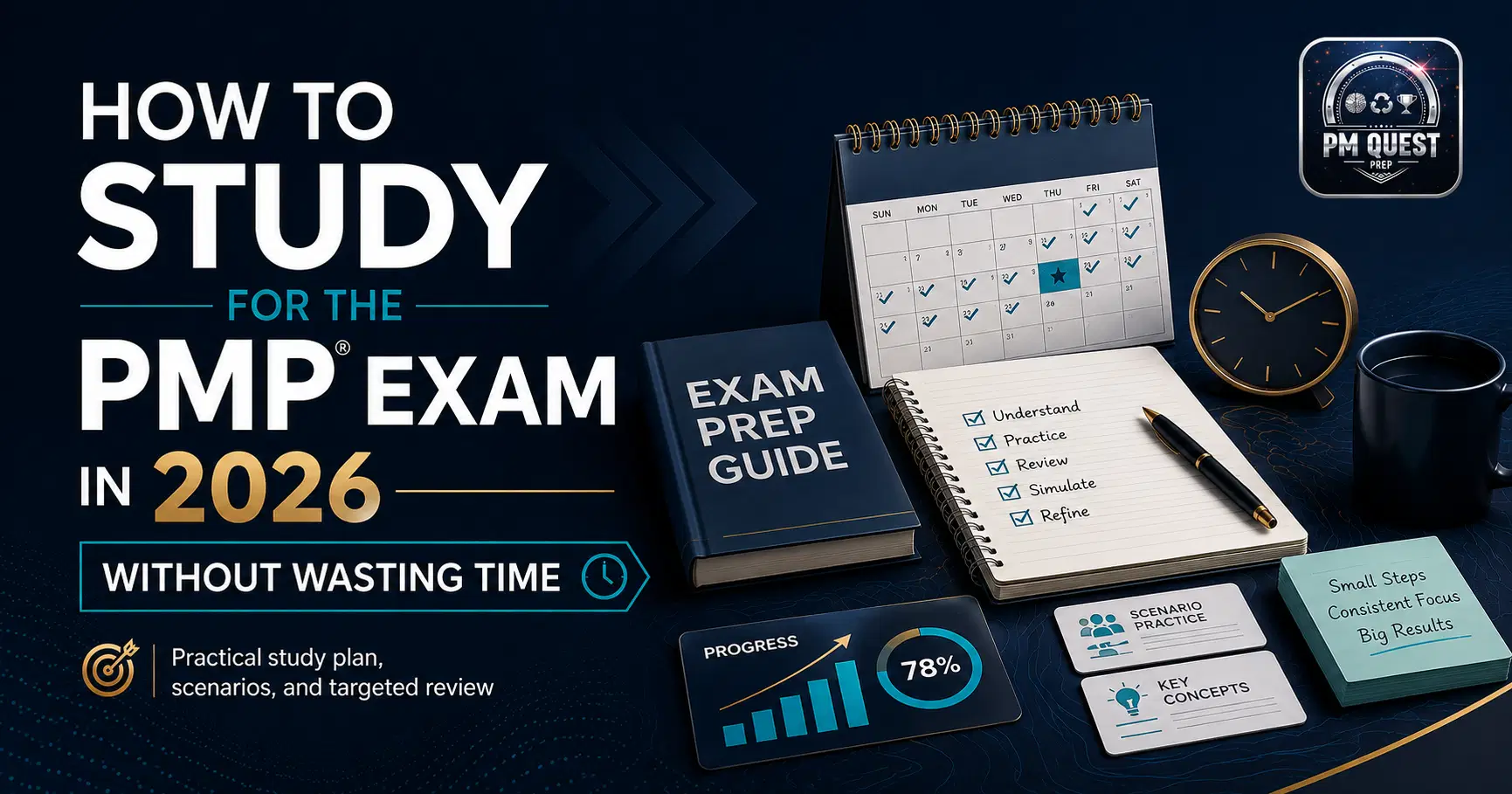
Preparing for the PMP exam does not require filling every spare hour with study materials. It requires a clear plan, deliberate practice, and regular review of the decisions behind each answer.
That distinction matters for working professionals. A busy schedule leaves less room for unfocused reading, repeated low-value quizzes, and study sessions that produce activity without improving understanding.
The most efficient approach to PMP exam preparation is to study from the current blueprint, practice realistic scenarios, learn from mistakes, and adjust your routine based on evidence. The following PMP study strategy is designed to help you make better use of the time you already have.
Start with the July 2026 PMP Examination Content Outline
For the current PMP exam, start with PMI’s July 2026 PMP Certification Examination Content Outline.
The July 2026 ECO confirms:
- 180 total questions
- 240 minutes of exam time
- Two 10-minute breaks
- People: 33%
- Process: 41%
- Business Environment: 26%
The ECO also states that predictive, adaptive/agile, and hybrid approaches appear across the domains. Approximately 40% of items represent predictive approaches, while the remaining 60% are divided between adaptive/agile and hybrid approaches. The exact distribution may vary by exam form.
Review the official July 2026 PMP Examination Content Outline before building your schedule.
Turn the ECO into a study checklist
The ECO is organized into:
- Domains: Broad areas of project management responsibility
- Tasks: Responsibilities a project manager may perform
- Enablers: Illustrative examples that help explain each task
Create a simple checklist with one line for each task. Then add three columns:
| Task | Confidence | Evidence |
|---|---|---|
| Task or topic | Green, amber, or red | Notes from practice and review |
Use green for topics you can explain and apply. Use amber for topics that require more practice. Use red for topics you regularly misunderstand or guess.
This turns the ECO into an active plan. It also prevents you from spending equal time on every topic when your performance shows that some areas need more attention.
Study scenarios, not isolated facts
The ECO explains that candidates must apply project management concepts and experience to on-the-job situations through scenario-based questions. That means memorizing definitions alone is unlikely to be an efficient PMP study strategy.
When you study a concept, ask:
- What situation does this concept address?
- What information would a project manager need first?
- Which project approach or context applies?
- What is the immediate need in the scenario?
- What action supports the team, process, value, governance, or project outcome?
For example, do not study risk responses only as a list of terms. Practice identifying whether a situation describes an uncertain event, an active issue, an impediment, or a change request. The useful knowledge is not only the definition. It is knowing how the distinction affects the next step.
[Image placement note: Add an approved PM Quest Prep branded visual illustrating scenario-based PMP study here.]
Use a consistent scenario-reading method
A practical method for PMP practice questions is:
- Identify the situation. What happened, and what is the question asking?
- Determine the context. Is the project predictive, adaptive/agile, or hybrid?
- Find the immediate need. Does the team need clarity, information, collaboration, a decision, or escalation?
- Remove premature actions. Be cautious about choices that skip analysis, communication, alignment, or an established process.
- Compare the remaining answers. Choose the response that best fits the facts and supports the project’s objectives.
These are study heuristics, not guaranteed PMI rules for every question. The scenario controls the answer. Avoid applying a memorized formula when the facts point somewhere else.
Use PMP practice questions as a learning tool
Practice questions are most valuable when they expose how you think. A score can show a result, but it does not explain whether you understood the topic, eliminated options correctly, or guessed successfully.
After each question, record one of three outcomes:
- Correct and understood
- Correct but uncertain
- Incorrect
The second category is important. A correct answer based on weak reasoning is still a review opportunity.
Review every important question
For questions you missed or answered with uncertainty, write down:
- The topic or ECO task
- What the question was testing
- The key facts in the scenario
- Why your selected answer was wrong
- Why the best answer was better
- What you will review next
A simple error log might look like this:
Example error log entry: Stakeholder engagement
- What the question tested: Tailoring communication
- Why my answer was wrong: I chose a broad update before analyzing needs.
- Why the best answer was better: The better option addressed the stakeholder’s specific concern first.
- Next review: Stakeholder analysis and communication
Example error log entry: Risk and issues
- What the question tested: Difference between risk and issue
- Why my answer was wrong: I treated an active problem as an uncertain event.
- Why the best answer was better: The situation required issue resolution and collaboration.
- Next review: Risk-to-issue transitions
Do not copy long explanations into your notes. Reduce each mistake to a short rule or decision point that you can recognize in another scenario.
Track weak areas and change your study plan
A PMP study plan should change as your evidence changes. If you continue taking mixed quizzes without reviewing patterns, you may spend time practicing the same mistakes.
At the end of each week, review:
- Which ECO tasks produced the most errors?
- Which topics caused uncertainty even when answers were correct?
- Are errors caused by knowledge gaps, misreading, pacing, or answer comparison?
- Are you struggling with one project approach more than another?
- Are you improving after reviewing the explanation?
Then adjust the next week’s schedule.
For example, if your results show repeated confusion around governance and change control, replace one general quiz session with a focused review session. If you understand the topic but lose accuracy under time pressure, use shorter timed sets rather than reading another chapter.
Do not use arbitrary score thresholds as proof that you are ready. Practice results are useful evidence, but they are not a guarantee of exam performance. Look for stronger reasoning, fewer repeated errors, better pacing, and more consistent performance across topics.
Mix focused practice with full simulated exams
Focused practice and full simulations serve different purposes.
Use focused practice when you need to learn
Choose a domain or task-focused session when:
- You are beginning a topic
- You have recurring errors in one area
- You need to compare predictive, adaptive/agile, and hybrid contexts
- You want immediate feedback
- You are reviewing an error log
Focused practice helps you isolate a problem. It is usually more efficient than taking a full exam when you are still building understanding.
Use full simulations when you need to test endurance
A full simulation is useful when you can already work through mixed scenarios and want to assess:
- Pacing across the complete exam duration
- Concentration over an extended session
- Break timing
- The effect of uncertainty on decision-making
- Whether weak areas appear again in a mixed environment
Because the official July 2026 ECO describes a 180-question, 240-minute exam with two 10-minute breaks, use a simulation that clearly explains the structure it is designed to represent. Confirm any current exam delivery details directly with PMI.
After a simulation, do not immediately take another one. Reserve time to review the questions that were wrong, uncertain, or unusually slow.
Build a realistic weekly PMP study plan
A workable routine is better than an ambitious schedule that collapses after one busy week. Plan around your actual responsibilities, not an idealized version of your calendar.
Here is one flexible example for a working professional:
Monday: Short review
Spend 20 to 30 minutes reviewing flashcards, glossary terms, or notes from your error log.
Tuesday: Focused practice
Complete a short set on one ECO task. Review every incorrect or uncertain answer.
Wednesday: Break or light study
Use this day for a brief explanation review, or take a planned break.
Thursday: Mixed practice
Complete a mixed set covering more than one domain or approach. Focus on reading the scenario carefully.
Saturday: Longer session
Study for 60 to 120 minutes. Alternate between focused review and timed practice based on your weekly performance.
Sunday: Weekly review
Update your checklist and error log. Choose the next week’s priority topics.
[Image placement note: Add an approved PM Quest Prep branded visual for a flexible weekly study routine here.]
If your schedule changes, keep the sequence rather than the exact days:
- Review
- Practice
- Analyze
- Adjust
- Repeat
Short sessions can work well when they are specific. “Study project management” is difficult to start and difficult to measure. “Review three stakeholder-engagement errors and complete ten related questions” is clearer.
Avoid common time-wasting study habits
Some study habits feel productive but produce limited improvement.
Reading without testing
Reading can introduce a topic, but it does not show whether you can apply it. Pair each reading session with questions, a short explanation, or a scenario summary.
Taking questions without reviewing them
A large question count does not automatically create better understanding. Review incorrect, uncertain, and slow answers.
Repeating only comfortable topics
Familiar topics may produce better scores while leaving important gaps untouched. Use your performance data to choose some sessions outside your preferred areas.
Memorizing answer patterns
Rules such as “always choose the collaborative answer” can mislead you. The best response depends on the scenario, project context, and immediate need.
Switching resources too often
Choose a small set of reliable resources. Changing books, videos, and question banks every few days creates setup time and makes it harder to see progress.
Know when review is better than more questions
Additional questions are not always the best next step. Pause and review when:
- You cannot explain why the correct answer is better
- You are missing the same concept repeatedly
- You are guessing between two options
- You are answering correctly but cannot explain the scenario
- Your timing is worsening because you are rereading the same topic
- You are collecting notes faster than you can use them
Use the pause to revisit the relevant ECO task, create a short comparison, or explain the concept in your own words. Return to practice after you can describe the decision clearly.
Use a simple final seven-day review strategy
A final review should consolidate your preparation, not introduce an entirely new curriculum. This seven-day outline is a flexible option, not a PMI requirement or a universal formula.
- Day 7: Review the ECO checklist and identify remaining amber or red topics.
- Day 6: Complete focused practice for the highest-priority topic.
- Day 5: Review your error log and revisit recurring decision patterns.
- Day 4: Complete mixed, timed practice across domains and approaches.
- Day 3: Take a full simulation if you still need to assess pacing and endurance.
- Day 2: Review the simulation and key notes. Keep the session focused.
- Day 1: Use light review only. Confirm your appointment, delivery instructions, identification requirements, and other terms through your PMI account and official PMI instructions.
Do not measure the final week by hours alone. Measure it by clarity, consistency, and your ability to explain why an answer fits the situation.
Consider an optional structured study tool
PM Quest Prep is an independent study platform for PMP preparation. Candidates can access the platform on the web, iPhone, and Android.
Use it as one part of a broader plan, alongside the current PMI Examination Content Outline and other materials you have evaluated for accuracy. PM Quest Prep does not provide official PMI questions.
Final takeaway
Efficient PMP exam preparation is not about studying every available resource or maximizing the number of questions completed. It is about using the current ECO, understanding project scenarios, reviewing mistakes, tracking weak areas, and maintaining a routine you can follow around work and personal responsibilities.
Start with the blueprint. Practice with purpose. Review the reasoning behind each answer. Then adjust your PMP study plan based on what your performance shows.
Continue your PMP prep at https://pmquestprep.com
Disclaimer
PM Quest Prep is an independent educational platform. It is not affiliated with, sponsored by, endorsed by, or approved by PMI®. It does not provide official PMI exam questions.
PMP®, PMI®, PMBOK®, and related marks belong to Project Management Institute, Inc. Candidates should confirm the latest exam structure, scheduling information, eligibility terms, delivery instructions, and other policies directly with PMI and within their own PMI account.